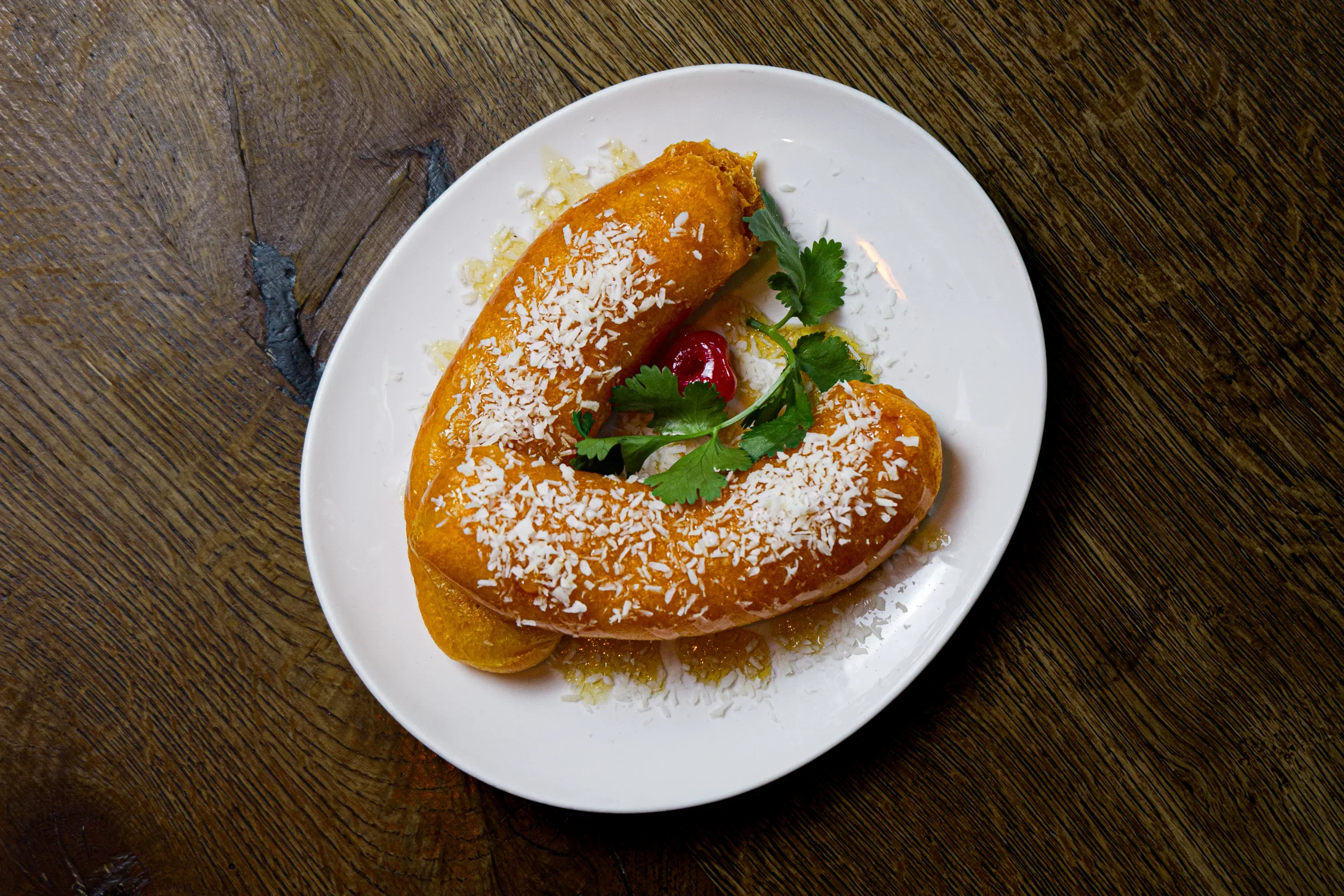
Imagine a dessert. In Europe, it would most likely involve butter, cream, chocolate, eggs, wheat flour, or baked pastry. It might be a cake, cheesecake, croissant, tiramisu, crème brûlée, or a slice of apple pie. Now, let’s transport ourselves to Vietnam. In a bowl, we might find mung beans, lotus seeds, pomelo segments, agar jelly, tapioca, coconut, and crushed ice.
In Thailand, a dessert might consist of sticky rice drenched in sweet and salty coconut milk and served with ripe mango. Or crispy pieces of water chestnut coated in starch, dyed red, and tossed into coconut milk with ice. What’s more interesting is that an Asian person wouldn’t necessarily eat such a dessert after dinner. They might eat it at 3 PM as a snack. In the evening at a street stall. On a hot day instead of a drink. During a festival. On the way home from school. Or as something between a dessert and a small meal. And this is where the most significant difference begins.
In Vietnam and Thailand, the category of ‘dessert’ is much less rigid than in Europe. Sweet food doesn’t have to be the finale of a meal. It can be a snack, a seasonal ritual, street food, an offering during a ceremony, or a way to survive a tropical afternoon. Therefore, instead of just asking: ‘What desserts do Vietnamese and Thais eat?’, it’s worth first asking: what does dessert actually mean in Asia?
European and Asian Desserts Don’t Start with the Same Ingredients
The history of European confectionery is strongly linked to milk, butter, cream, eggs, and wheat flour. The cuisines of Vietnam and Thailand developed under completely different conditions. The staple grain was rice. Coconut palms grew readily. Bananas, mangoes, durians, jackfruits, pomelos, and longans were available. Mung beans, soybeans, and sesame were cultivated. Sticky rice, tapioca, and various starches were used. Pandan, jasmine, pomelo flowers, or rose water were used for flavoring.
Therefore, for centuries, classic Thai dessert relied primarily on three ingredients: rice or rice flour, palm sugar, and coconut. Research into the history of Thai sweets confirms that rice, palm sugar, and coconut milk formed the basis of ancient khanom, before foreign influences introduced egg yolks, white sugar, and other techniques on a larger scale.
This difference in available products created a completely different logic of dessert. Instead of fluffiness, we have chewiness. Instead of flaky pastry, often springy jelly. Instead of buttercream, coconut milk. Instead of sponge cake, sticky rice. Instead of chocolate, mung beans, sesame, taro, or lotus.
For a European, the first reaction is often: ‘Is this really a dessert?’ For a resident of Hanoi or Bangkok, the question might sound as strange as asking a Pole if cheesecake is a dessert.
Chè: A Dessert That Is Virtually Untranslatable
If we want to understand Vietnamese desserts, we must start with the word chè. The simplest translation is ‘sweet soup.’ However, this is very misleading. Chè can have the consistency of soup. But it can also resemble pudding. A drink. An ice dessert. Compote. Jelly. Or a bowl filled with so many ingredients that defining it with a single European word ceases to make sense. The official Vietnam Tourism portal describes chè precisely as a broad family of sweet soups, drinks, puddings, and desserts prepared with a water or coconut base, with added jellies, fruits, beans, rice, grains, and tubers. This is one of the most important things to remember: chè is not a single recipe. Chè is a category. It’s a bit like using one word to describe pudding, ice cream, compote, and jelly simultaneously.
Beans in Dessert? In Vietnam, It’s Nothing Unusual
For many European visitors, beans come as a major surprise. We tend to associate beans with soup, chili con carne, or a dinner side dish. In Vietnam, however, various types of beans are a perfectly natural ingredient in desserts. Mung beans (*đậu xanh*) are particularly common; once cooked, they become soft and slightly starchy, with a delicate flavor. When blended, they form a creamy paste with a texture similar to a very thick purée. Their flavor is subtle, making them an excellent match for coconut, sugar, pandan, glutinous rice, sesame, and fruit. They appear in chè, pastry fillings, traditional Mid-Autumn Festival (Tết Trung Thu) cakes, and many other sweets. Vietnam Tourism lists mung beans as a common ingredient in *chè*, while *bánh đậu xanh*—a crumbly mung bean confection that practically melts in the mouth—stands out as a classic in its own right, particularly associated with the city of Hải Dương. It pairs traditionally well with hot tea.
Why do beans work well in sweets?
Because in the Asian way of thinking about ingredients, there isn’t such a strong division into ‘dessert’ and ‘main course’ products. A product is judged more by what can be done with it. Beans can be cooked with salt. But they can also be cooked with sugar and coconut. Sticky rice can accompany meat. But it can also be combined with mango. Pumpkin can go into soup. Or into a coconut dessert. The boundaries are more fluid.
Chè ba màu: A Dessert Built Primarily on Textures
One of the best first chè for someone who has never tried Vietnamese sweets before is chè ba màu. It literally means ‘three-color dessert.’ Most often, you’ll see layers of: red beans, yellow mung beans, green pandan jelly, plus coconut milk and crushed ice. Vietnam Tourism describes chè ba màu as a Vietnamese ‘rainbow dessert,’ where red beans, mung bean paste, and pandan jelly create layers finished with ice and coconut. citeturn217370search3 And here lies another very important difference between European and Asian desserts. In Europe, we often build a dessert around flavor. Chocolate. Vanilla. Strawberry. Coffee. In many Southeast Asian desserts, texture is as important as flavor. Soft. Springy. Gelatinous. Sticky. Crunchy. Smooth. Slightly chewy. A single chè can feature five different textures simultaneously. This is no coincidence. It’s part of the pleasure of eating.
Ice is an ingredient, not just a cooling method
The crushed ice in chè doesn’t work like ice cubes in Coca-Cola. It’s not just a way to lower the temperature. It’s part of the recipe. When the ice begins to melt, it dilutes the sweet syrup, mixes with the coconut milk, changes the dessert’s density, and combines the layers. Vietnam News describes chè bưởi served with crushed ice as a popular summer snack (also check out our guide on how to make it). What people eat and drink in Vietnam and Thailand in the summer). The ice tempers the sweetness and blends the various elements of the dessert. This is an important detail. If we taste an Asian dessert and find it too sweet before mixing it with the ice, we might be judging it prematurely. The dessert is designed to evolve as you eat it.
Chè bưởi: How to Make Dessert from Pomelo Peel?
This is one of those dishes that best showcases the creativity of Vietnamese cuisine. Chè bưởi is prepared, among other things, from the white part of pomelo peel. That is, from something most Europeans would discard. The white part of the peel is processed appropriately to remove bitterness. Then it is cut, cooked, and often coated with starch, creating small, springy, slightly crunchy pieces. Mung beans, a sweet base, and coconut cream are added. The effect is extraordinary. It’s not the taste of pomelo in the sense of orange juice. The texture of the peel is most important. Vietnam News describes chè bưởi as a popular combination of pomelo, mung beans, and coconut, especially enjoyed on hot days. It is also a beautiful example of an ancient culinary philosophy that utilizes a product much more thoroughly than just its most obvious part.
Lotus Can Be Eaten, and Not Just Its Root
In the European imagination, the lotus is primarily a flower. In Vietnamese cuisine, it is also an ingredient. Lotus seeds, hạt sen, are particularly important in desserts. When cooked, they become soft, delicate, and slightly nutty. They can be used to prepare chè hạt sen, a very simple dessert based on lotus seeds and sweet syrup. They can be combined with longan. With young green rice. With mung beans. With coconut. Vietnam Tourism lists chè with lotus seeds as one of the popular types of this enormous family of Vietnamese desserts. The lotus also holds much greater cultural significance in Vietnam than just an ordinary kitchen ingredient. The flower appears in art, symbolism, and architecture. The leaves are used to wrap food. The seeds go into sweets. The stems can be used in salads. Even the bitter embryo inside the seed has applications in traditional infusions. Again, the same principle is evident: the plant does not yield a single product. It offers a whole palette of culinary possibilities.
Pandan: The ‘Asian Vanilla’
When a European guest first sees an intensely green Asian dessert, they might suspect artificial coloring. Sometimes it is indeed used. But the traditional green color and characteristic aroma often come from pandan, Pandanus amaryllifolius. The long green leaves of pandan are used in Southeast Asian cuisines much like an aromatic herb. A few leaves can be tied together and cooked with rice. They can be blended with water to extract green juice. They can be used to flavor coconut milk, cakes, jellies, and puddings. What does pandan taste like? It’s one of those questions that’s hard to answer until you try it. It’s herbaceous, slightly vanilla-like, a bit nutty, sometimes compared to freshly cooked rice. However, it is not a substitute for vanilla. It has its own very distinct aroma. In Thai khanom chan, pandan juice gives the dessert both color and aroma. The traditional recipe is based on rice flour, tapioca starch, coconut, and sugar.
Why are so many Asian desserts sticky?
Another surprise for the European palate: dessert can be intentionally very sticky. This is not a flaw. It is a desired texture. One of the most important ingredients is sticky rice, also called glutinous rice. The name can be misleading: this rice does not contain gluten. ‘Glutinous’ refers to its stickiness. When cooked, the grains bind tightly together. This rice can be formed into balls, wrapped in banana leaves, mixed with coconut, or used to prepare sweet fillings. In central Thailand, ordinary non-sticky rice is the basis of meals, while sticky rice traditionally had a particularly strong application precisely in desserts. And from this, we arrive at the dessert that has become a global ambassador for Thai sweets.
Mango Sticky Rice: Why Does Rice with Mango Even Work?
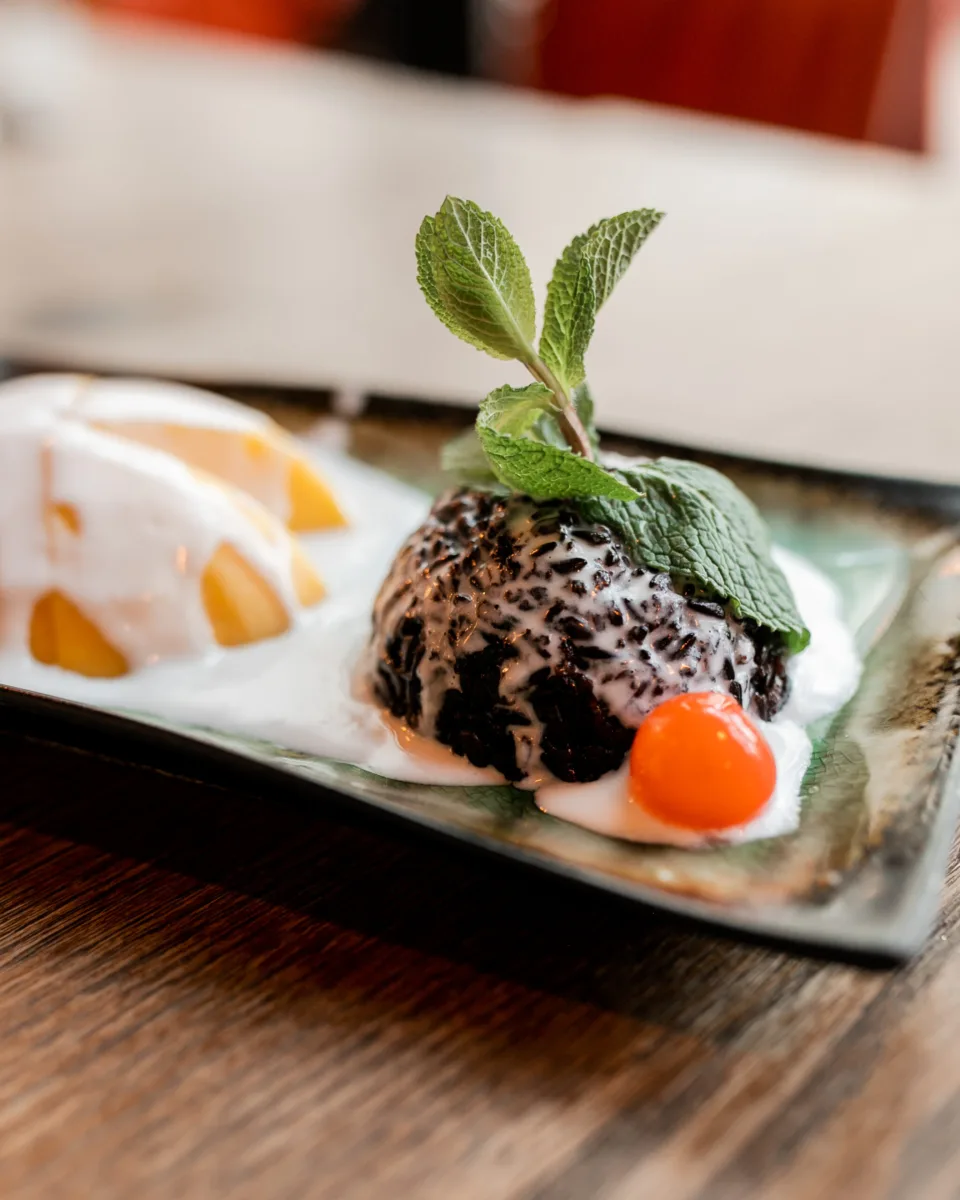
Khao niao mamuang — or mango sticky rice — is conceptually very simple: ripe mango, sticky rice, coconut milk, sugar, and salt. Alongside iconic savory dishes like Pad Thai, this sweet classic has won the hearts of food lovers around the world.
The most important part, however, is how the rice is prepared. Glutinous rice is steamed and then, while still hot, mixed with seasoned coconut milk. The rice absorbs the liquid; it should not turn into a pudding. It ought to retain its grain structure while becoming creamy, slightly sweet, and coconut-flavored. It is served alongside ripe, aromatic mango, often with an extra drizzle of coconut sauce on top.
The key detail? Salt. Good coconut milk for mango sticky rice isn’t just sweet; the saltiness balances the sugar and makes the mango taste even more intense. The Thailand Foundation identifies mango sticky rice as a classic Thai dessert—one particularly associated with mango season, even though it is available year-round these days. This highlights another characteristic of Thai confectionery: a sweet dessert doesn’t have to taste exclusively sweet.
Coconut is Not the Equivalent of European Cream
Many people say: ‘Asians use coconut milk instead of cream.’ This is only partially true. Coconut has a much broader role. From one fruit, you can get: coconut water, flesh, coconut milk, thick coconut cream, shredded coconut, toasted coconut, coconut oil. In desserts, its consistency and fat content can be adjusted. Sometimes coconut is the main flavor. Sometimes it is just a creamy counterbalance to something very sweet. Sometimes it provides the fat needed to achieve a soft texture. In traditional Thai sweets, it is one of the absolutely fundamental ingredients. In Vietnam, it also appears practically everywhere, especially in the south, where coconut palms are part of the Mekong Delta landscape.
Tapioca: These Small Transparent Balls Have a Specific Function
Tapioca is made from cassava starch. When cooked, it becomes almost transparent and characteristically springy. It can appear as pearls. Strands. Flakes. Or as starch itself, used for thickening. In Vietnamese chè chuối, tapioca appears alongside banana and coconut milk, creating something between a pudding and a sweet soup. Vietnam Tourism describes this dessert as a creamy combination of banana, tapioca, and coconut. From the perspective of European culinary tradition, tapioca might seem like a strange addition. In Asia, its springy consistency is part of the dessert’s appeal. We return to textures once again.
Agar: Why Asian Jellies Behave Differently
Another ingredient worth knowing is agar. It is extracted from algae. Unlike gelatin, it is not animal-derived. When boiled in liquid and cooled, it forms a jelly. But its texture is different from classic gelatin. It is more brittle. It holds its shape more firmly. It can be easily cut into cubes and layers. Therefore, it is ideal for Asian desserts. In Vietnam, agar is used to prepare rau câu, colorful jellies that come in dozens of variations, often with coconut milk, pandan, coffee, or fruits. In Thailand, agar plays an even more artistic role.
Luk Chup: Beans That Pretend to Be Fruit
They look like miniature mangoes. Or oranges. Or mangosteens. Sometimes chilies. They are two centimeters long and shine like porcelain figurines. These are luk chup. Inside is a sweet mung bean paste, often prepared with coconut. The mixture is hand-formed into miniature fruits and vegetables. Then each element is painted. Finally, it is dipped several times in agar jelly. After setting, a shiny, slightly springy coating forms. The Thailand Foundation describes luk chup as a Thai dessert made from mung bean paste modeled into tiny fruits, painted, and coated with agar. Its history is likely linked to Portuguese almond-based sweets, which were adapted in Thailand to local products, replacing almonds with more readily available mung beans. This is a wonderful example that traditional Thai dessert is sometimes more artistic craft than a quick way to eat sugar.
Thai Desserts Have Portuguese DNA
This is one of the most surprising stories in all of Thai cuisine. If we look at classic Thai sweets: thong yip, thong yod, foi thong, we immediately notice something unusual. They are intensely yellow. They are prepared with a huge amount of egg yolks and sugar. This is not typical of the oldest layer of Thai confectionery. A major change occurred during the Ayutthaya kingdom period. A special role is attributed to Maria Guyomar de Pinha, known in Thailand as Thao Thong Kip Ma, a woman of Portuguese-Japanese-Bengali descent associated with the Siamese court at the turn of the 17th and 18th centuries. Previously, the basis of Thai sweets was primarily rice, coconut, and palm sugar. With Portuguese influences, egg yolks and cooking them in sugar syrup began to play a significant role. The most extraordinary example is foi thong.
Foi Thong: The Thai Dessert That Looks Like Golden Noodles
Egg yolks are spread in very thin strands over hot sugar syrup. Upon contact with the liquid, they immediately set. Long, thin golden threads are formed. They look a bit like noodles. They taste like an incredibly delicate, intensely sweet egg dessert. The technique is very closely related to Portuguese fios de ovos. However, Thailand did not copy the dessert one-to-one. It adapted it, incorporated it into its own language, aesthetics, and symbolism. And after several hundred years, foi thong is perceived as a classic element of Thai tradition. This is an excellent example of how culinary culture truly works. It is not a closed museum. It borrows, changes, and transforms ingredients until they become its own.
Why are so many Thai desserts golden?
Because the word ‘thong’ in Thai means gold. The color gold is associated with success, wealth, and prosperity. Therefore, some classic desserts from the ‘thong’ family have significance beyond taste. Thong yip resembles a small golden flower. Thong yod are golden drops. Foi thong means golden threads. These types of desserts are part of the khanom mongkhon tradition, which are auspicious sweets served on important occasions such as weddings, ceremonies, housewarmings, or professional events. The dessert thus becomes a wish. One is not just given a candy. One is given a symbol: of wealth, long-lasting success, development, happiness. This is a completely different dimension of eating sweets.
Khanom Chan: Nine Layers of Success
This is very evident in the khanom chan dessert. It is soft, slightly sticky, and springy. Its appearance can resemble a multi-layered jelly. It is made from a mixture of various flours and starches, coconut milk, and sugar. The green layers are traditionally flavored with pandan. One layer is steamed. Then the next. Then another. The traditional version can have nine layers. Why nine? Because the number nine in Thai culture is associated with luck and progress, and the word for layer, chan, can symbolically suggest successive levels of development. The Thailand Foundation lists khanom chan among the nine auspicious Thai desserts and describes its multi-layered steaming technique. In Europe, we decorate a cake with the inscription ‘Good luck.’ In Thailand, sometimes the dessert itself is a wish for good luck.
Mango, Banana, and Durian Don’t Have to End Up as Smoothies
Fruits are one of the most important categories of Asian sweets. But there is a significant difference. In the tropics, a good fruit is often intense enough not to need complex processing. Perfectly ripe mango. Mangosteen. Rambutan. Longan. Durian. Jackfruit. Sometimes the best ‘dessert’ simply means a plate of fruit. Old studies of Thai customs even indicate that historically, fruits were the primary form of a sweet ending, while more elaborate sweets made from flour, sugar, and coconut were prepared especially for ceremonies and festivals. But fruits can also be treated completely differently.
Chuối Nếp Nướng: Grilled Banana in Sticky Rice
In southern Vietnam, you’ll find chuối nếp nướng. A banana is wrapped in a layer of sticky rice. The whole thing is then wrapped in a banana leaf. Then it’s grilled. The rice on the outside begins to lightly char. Inside, the banana softens and caramelizes. The finished portion is cut into pieces and drizzled with coconut sauce. Sometimes toasted peanuts are added. Vietnam Tourism describes chuối nếp nướng as a typical South Vietnamese street food, combining banana, sticky rice, the aroma of grilled banana leaf, coconut, and peanuts. For a European, grilling is associated with sausage. In Saigon, dessert can come off the grill.
A Sweet Dessert Can Be Hot
Another European habit: we eat ice cream in summer. Warm desserts in winter. In Vietnam, seasonality also exists, but the division is more interesting. Chè can be served both cold and hot. In summer, versions with ice, fruit, and coconut are extremely popular. In cooler Hanoi, hot sweet soups can be found in winter. Vietnam Tourism notes that even tào phớ, a delicate tofu pudding, is sometimes served with jasmine syrup and ice in summer, while its hot version can be bought on the streets of Hanoi in winter. The same dish can thus undergo a seasonal metamorphosis.
Tofu as Dessert
Yes, tofu. Tào phớ is a very delicate tofu with a consistency much softer than the block tofu used for frying. It resembles a silky pudding. The tofu itself is practically neutral. The flavor is built only by the syrup. In Hanoi, it might smell of jasmine. Ice can be added. Tapioca. Jelly. Coconut. In other versions, ginger syrup appears. This is another example of a product that in Europe would likely fall into the ‘healthy protein’ category, but in Asia functions perfectly well as a dessert. And the same applies to soy, beans, or rice.
Dessert Does Not Always Follow Dinner
This is one of the most important cultural details. In a European restaurant, the natural order is: appetizer, main course, dessert, coffee. In traditional daily eating in Vietnam or Thailand, such a structure is not as mandatory. Of course, modern restaurants use the European meal model. But many traditional sweets function primarily as đồ ăn vặt, or snacks. Chè is bought in specialized establishments. You can stop for it after school. After work. In the evening. During a walk. At the market. Vietnam Tourism repeatedly describes Vietnamese sweets as street food and snacks, not exclusively the finale of a full meal. This is very important because it changes the way one views a portion. A bowl of chè with beans, sticky rice, and coconut can be much more filling than a piece of jelly. However, it doesn’t have to appear after a hearty dinner. It can be an event in itself.
Chè as a Meeting Place
In Vietnam, there are establishments specializing almost exclusively in chè. Some are very simple. A few plastic stools. Metal containers full of colorful ingredients. Crushed ice. Jars of syrups. Coconut. The customer chooses a specific type or orders chè thập cẩm, a mix of many additions. This is incredibly social food. You can come in the evening with friends and, instead of meeting ‘for a drink,’ stop for a sweet snack. In a hot climate, cold chè serves both as a dessert and a refreshment. Vietnam Tourism describes stopping at street chè stalls as a characteristic element of Vietnamese sidewalk culture and hot days.
Asian Dessert Can Be Drunk, Eaten with a Spoon, or Bitten
This also shows why the European definition of dessert is too narrow here. Chè can be liquid enough to almost be drunk. Khanom chan is eaten by hand. Mango sticky rice is eaten with a spoon or fork. Bánh đậu xanh crumbles in the mouth and is usually accompanied by tea. Luk chup can be eaten like a small praline. Tào phớ is so delicate that it practically melts on the spoon. Rau câu is springy and cool. Each of these desserts offers a completely different sensory experience.
Tea and coffee are more important than they might seem.
Very sweet Asian desserts are often designed to be paired with something bitter or unsweetened. A prime example is the Vietnamese *bánh đậu xanh*. The cake itself is intensely sweet, crumbly, and rich in flavor. However, when paired with hot green tea (or served alongside aromatic Vietnamese coffee), the balance shifts completely. Vietnam Tourism actually recommends enjoying this specialty from Hải Dương with hot green tea. The culture surrounding *bánh Trung Thu* follows a similar pattern; it is not meant to be eaten as a massive whole cake by a single person. Instead, it is sliced into small pieces, shared, and enjoyed with tea. A European trying the entire portion without this context might conclude, “It’s terribly sweet.” An Asian person might reply, “That’s because you weren’t supposed to eat the whole thing by yourself.”
Salt in Dessert Is Not a Mistake
Coconut sauces in Thailand often contain salt. In mango sticky rice, they even need it. Why? Because salt enhances the aroma of coconut and mango and reduces the sensation of excessive sweetness. It’s a similar principle to a pinch of salt in caramel. Except that in Thai cuisine, the contrast is often more pronounced. Therefore, a dessert can simultaneously be: sweet, salty, creamy, fruity. Asian cuisine less often confines flavor to a single category.
And Sometimes Dessert Is Prepared Together for Eight Hours
Sweets also have a social and ceremonial function. The Thailand Foundation describes an interesting example of the Mon community during Songkran. Kalamae, a very thick, sticky dessert made from sticky rice flour, palm sugar, and coconut milk, is prepared then. The mixture must be stirred in large pots for 4 to 8 hours. Therefore, the preparation becomes a community effort. One person would find it difficult to handle the heavy, thickening mass alone. So, residents take turns stirring. They talk. They work. They prepare food that will later also be for monks and older family members. Here, dessert ceases to be a product. It becomes an activity that builds community.
Sweets for Ancestors, Monks, and Guests
A European dessert is most often prepared for people who will eat it at the table. In Asia, sweet food can also be part of religion. It is brought to the temple. Offered to monks. Placed on the home altar of ancestors. Prepared during ceremonies. In the traditions of various Thai communities, sticky rice, coconut, and sugar sweets are part of merit-making, practices associated with accumulating good karma. The Thailand Foundation documents such use, among others, during Mon and Khmer ceremonies in Thailand. Therefore, the question: ‘When do Thais eat dessert?’ has many more than one answer. After a meal. On the street. During a festival. At a wedding. In a temple. During a significant life change.
Why are Thai desserts so beautiful?
Because aesthetics are part of their value. The cuisine of the Thai royal court developed an exceptionally high level of precision in preparation and presentation over centuries. A fruit could be intricately carved. A sweet was meant to resemble a flower. Miniature luk chup was meant to look almost like real mangoes. Thong yip was shaped into a golden flower. Khanom chan was arranged layer by layer. The Thailand Foundation emphasizes that precision of execution, colors, aromas, and symbolic shapes are among the most important characteristics of traditional Thai confectionery. A dessert is thus meant to first attract the eye. Then the nose. Only then the tongue.
Natural Perfumes in Dessert: Jasmine, Pomelo, and Flowers
A hundred years ago, a confectioner didn’t have a bottle of synthetic vanilla extract. But they had a garden. In Southeast Asia, there is a long tradition of flavoring sweets with flowers. In Vietnam, syrup for tào phớ might smell of jasmine. Bánh dẻo might be flavored with pomelo flower water. In Thailand, fragrant waters were used in court and ceremonial desserts. Added to this are pandan, banana leaves, coconut, and spice aromas. As a result, Asian dessert often smells more of plants and gardens than of a vanilla confectionery. For a European, this is one of the most fascinating differences.
Bánh da lợn: The Dessert Named ‘Pig Skin’
This is a name that definitely deserves an explanation. Bánh da lợn literally means something like ‘pig skin cake.’ Don’t worry. There’s no pig skin in it. The name refers to its appearance and characteristic springy texture. It’s a multi-layered Vietnamese steamed dessert. Traditionally, green layers flavored with pandan and yellow layers made from mung beans are intertwined. The ingredients also include tapioca starch, rice flour, and coconut milk. The layers are steamed one after another. After cooling, the cake becomes elastic, soft, and slightly chewy. VietnamPlus describes bánh da lợn as a layered dessert based on mung beans, tapioca, rice flour, and coconut, often flavored with pandan. If you expect the texture of sponge cake, you might be surprised. If you treat it as a separate category, it becomes very interesting.
Asian Desserts Do Not Try to Be European Desserts
This is probably the most important thing to know before your first taste. You shouldn’t expect a mung bean dessert to taste like vanilla cream. That agar will have the structure of panna cotta. That mango sticky rice will be the equivalent of rice pudding. That chè will be an Asian milkshake. These are different culinary traditions. Each developed its own criteria for what is pleasurable. European confectionery taught us to love: crispiness, fluffiness, butteriness, chocolaty richness, creaminess. The cuisines of Vietnam and Thailand teach us to appreciate: stickiness, springiness, gelatinousness, contrast of temperatures, coconut richness, the natural aroma of leaves and flowers, the blending of beans, rice, fruits, and sugar. Neither of these systems is more ‘normal.’ We are simply accustomed to one of them.
How to Start Your Adventure with Asian Desserts?
If someone has never tried sweets from Vietnam and Thailand before, it’s worth starting gradually. Mango Sticky Rice will be the most intuitive. Mango and coconut are familiar, and sticky rice introduces the first important textural difference. Later, you can try chè chuối, where banana meets coconut and tapioca. The next step is chè ba màu, which introduces beans, pandan jelly, and ice. Then bánh da lợn or khanom chan, to experience springy, steamed cakes. And finally, it’s worth trying something that completely breaks the European mold, such as chè with beans and lotus, or Thai sweets made from egg yolks cooked in syrup. Not to tick off the most exotic product. But to see how broad the definition of the word ‘dessert’ can be.
What Does Asian Dessert Say About Culture?
A great deal. Mango Sticky Rice speaks of the seasonality of tropical fruits. Chè speaks of Vietnamese street life. Khanom chan shows the importance of symbolism and lucky numbers. Foi thong tells the story of Siam’s contact with Portugal. Bánh da lợn shows the importance of rice, coconut, and tapioca. Luk chup speaks of the precision of Thai craftsmanship. Bánh đậu xanh about the culture of drinking tea. Kalamae about a community that stirs a single mixture together for many hours. Thus, in Asian desserts, you find exactly what you find in the best savory dishes: geography, climate, history, migrations, religion, and family customs.
Vietnamese and Thai Desserts at Wi-Taj
At Wi-Taj, we have always been interested in the cuisines of Vietnam and Thailand—not merely as a collection of a few iconic dishes, but as part of a broader food culture. Desserts are a perfect example of this. For someone raised on cheesecake and apple pie, a first encounter with sticky rice, coconut, tapioca, or Asian jelly can be a completely new experience. And therein lies their greatest charm.
In addition to our iconic desserts, the Wi-Taj menu offers a full range of authentic savory dishes from both of these unique countries.
Do you want to try authentic Asian flavors in Warsaw?
Book a table at Wi-Taj at Plac Konstytucji 4 or order your favorite dishes for delivery straight to your home!
Bibliography and sources
- Vietnam National Authority of Tourism, “TOP tasty Vietnamese treats to satisfy your sweet tooth.” An overview of chè, rau câu, bánh đậu xanh, tào phớ, pandan cakes, chuối nếp nướng, and other traditional sweets.
- Vietnam National Authority of Tourism, “21 must-try Vietnamese dishes.” Characteristics of chè and chè ba màu and typical ingredients such as mung beans, jellies, fruits, coconut, and crushed ice.
- Vietnam National Authority of Tourism, “15 dreamy desserts to try in Vietnam.” Materials on chè chuối, chè trôi nước, chè bắp, bánh chuối chiên, and other sweet snacks.
- Vietnam News, “Cool down amid the summer’s heat with chè.” Source regarding the cultural role of chè as a summer snack and chè bưởi prepared with pomelo, mung, and coconut.
- VietnamPlus, materials on Asian desserts. Information on chè, bánh da lợn, rau câu, and the use of mung, tapioca, pandan, and coconut.
- Chatranok Boonchai, “Thai dessert: Tradition aspect,” Journal of Thai Food Culture. A study on the history of Thai desserts, their ceremonial functions, and basic ingredients: rice, palm sugar, and coconut.
- Thailand Foundation, “Nine Auspicious Thai Desserts.” Detailed study of khanom mongkhon, the symbolism of Thai desserts, khanom chan, and historical ingredients of Thai confectionery.
- Thailand Foundation, “Women in Thai Cuisine: The Classical Era.” The history of Maria Guyomar de Pinha and Portuguese influences on Thai egg yolk-based sweets, including thong yip, thong yod, and foi thong.
- Thailand Foundation, “Luk Chup: The Artful Thai Dessert That Blends History and Flavor.” History and technique of making luk chup from mung bean paste, coloring, and agar coating.
- Thailand Foundation, “A Beginner’s Guide to Seasonal Thai Fruits.” Resource on the seasonality of tropical fruits and mango sticky rice.
- Thailand Foundation, “Central Thai Cuisine”. Information on the regional role of coconut and the traditional use of sticky rice in Central Thai desserts. citeturn331281search0
- Thailand Foundation, “Royal Thai Cuisine.” Context of aesthetics, precision, and foreign influences on the development of Thai court cuisine and sweets.
- Thailand Foundation, “Mon Songkran in Thailand.” Documentation of kalamae and the social, multi-hour preparation of desserts during holidays and ceremonies.
- Yuka Utsunomiya, “Traditional Confectionery Cultures of Southeast Asia Using Agar and Mung Beans: Cultural Trajectories in Thailand and Vietnam”, 2026. Comparison of Thai and Vietnamese confectionery traditions based on mung beans and agar.