When we think of summer food in Poland, strawberries, cold soup, barbecues, and ice cream come to mind. In Vietnam and Thailand, summer tastes completely different. It is sour from tamarind and green mango, smells of fresh herbs, street grill smoke, and jasmine, crunches with ice in desserts, and sometimes takes the form of… rice submerged in ice-cold floral water. Interestingly, the word “summer” itself requires a little explanation here.
In Thailand, the official hot season falls primarily in March, April, and May, when temperatures often range around 28–38°C. European holidays in July and August largely fall during the rainy season.
In Vietnam, the situation is even more complicated. The country stretches over 1,600 kilometers from north to south (as described in our guide to Vietnam’s most beautiful regions), so Hanoi can have completely different weather than Đà Nẵng or the Mekong Delta. The north is hot, humid, and rainy in summer, central Vietnam remains sunny for long periods, while the south is warm year-round, with frequent, intense, short downpours from June to August. And this climate is one of the reasons why, over generations, the inhabitants of both countries have developed their own repertoire of dishes for hot days.
However, this does not mean that once temperatures exceed 30°C, Vietnamese and Thai people stop eating hot soups or spicy dishes. On the contrary. The Asian response to the heat is much more interesting than simply “let’s eat everything cold.”
Vietnamese summer starts with… a bowl of noodles and a mountain of fresh herbs
One of the biggest misconceptions about Vietnamese cuisine is reducing it to phở. Phở is important, but on a hot day, many Vietnamese people readily reach for dishes featuring bún—thin rice noodles served with meat, vegetables, fresh herbs, and a light sauce.
The official Vietnam Tourism portal explicitly points out that when it gets hot, lighter noodle dishes with plenty of crunchy lettuce and herbs become popular. As examples, it cites bún chả and bún thịt nướng.
Bún chả, or summer in Hanoi
Bún chả is one of the most characteristic dishes of Hanoi. Served separately on the table are grilled pork, bún rice noodles, fresh herbs, and a slightly sweet-and-sour fish sauce-based sauce. It is not a heavy dish drenched in a thick sauce. Its essence is contrast. Warm, slightly charred meat meets cooler noodles, fresh leaves, and the acidity of the sauce. This is a very Vietnamese way of composing a meal. Instead of a single dominant flavor, we get several elements that balance each other out.
That is why in summer it is not always about lowering the temperature of the food. Often, it is more important to create a dish that feels fresh, juicy, and light, even if some of the ingredients have just come off the grill.
Bún chả is also on the Wi-Taj menu in the classics section, where it is served with grilled pork, rice noodles and fresh Vietnamese herbs.
Sour is good for the heat. Meet canh chua
If there is a flavor particularly associated with southern Vietnam, it is pleasant sourness. One of the best examples is canh chua, a sour soup prepared in various versions with fish or seafood.
In the Mekong Delta, it can be found with tamarind, pineapple, tomatoes, sprouts, okra, and local vegetables. Vietnam Tourism lists canh chua as a characteristic dish of the Mekong Delta region. This is an interesting example of how different Asian thinking about food during the heat can be.
A European might say, “It’s 35 degrees. Soup? Absolutely not.” A Vietnamese might respond with a bowl of hot, aromatic, and highly sour soup. One resident of Lý Sơn Island, reported by Việt Nam News, even explained that local families enjoy making sour fish soup during the heatwave. The local version features tamarind, tomatoes, okra, sprouts, herbs, and fish, among other ingredients.
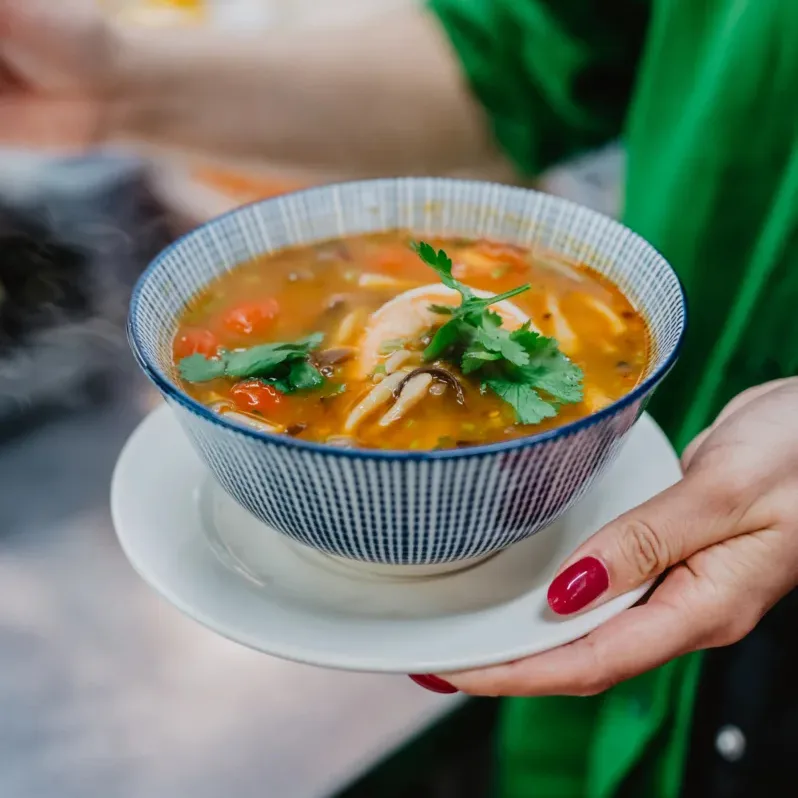
Canh chua also shows something important about Vietnamese cuisine: sourness doesn’t have to come from lemon. It can be provided by tamarind, sour mango, star fruit, fermented rice, or other local ingredients. It is precisely details like these that make two similar-looking bowls of soup taste completely different depending on the region and the family recipe. At Wi-Taj, you can try our Canh Cá Chua, a sour soup with fish, tomatoes, and pineapple.
Looking for refreshing flavors in the capital? Browse our Thai and Vietnamese soup menu.
And when it’s really hot? Vietnamese people go for chè
If, while traveling through Vietnam, you see a small venue filled with plastic stools and people leaning over colorful glasses in the evening, you’ve probably stumbled upon chè.
Translating chè as “dessert” doesn’t explain much. It’s actually a whole family of Vietnamese sweets. Chè can resemble a pudding, a sweet soup, a drink, or an ice cream sundae. The fillings may include mung beans, red beans, lotus seeds, tapioca, pandan jelly, fruit, coconut, and crushed ice.
And this is where the true culture of Vietnamese summer begins. Vietnam Tourism describes stopping at a street stall for a bowl of icy chè as one of the typical ways locals cope with the scorching summer heat. Chè is purchased from small shops, mobile carts, and street vendors.
In Đà Nẵng, locals are known to spend long, warm afternoons and evenings over chè. It is not a dessert reserved exclusively for an elegant end to dinner. It is also a snack—an excuse to pause, meet up, and wait out the worst of the heat.
It’s hard to imagine hot days without the iconic iced coffee with condensed milk – see how Vietnamese coffee became a national symbol.
Kem bơ, a dessert worth seeking out in Đà Nẵng
In Đà Nẵng, there is yet another summer ritual that is talked about much less outside of Vietnam than bánh mì or phở. It is kem bơ, a creamy dessert made with avocado and coconut ice cream.
Vietnam Tourism describes it as a favorite way for students and locals to cool off on particularly hot days. Thick, mashed avocado is combined with coconut ice cream, and the whole thing can be topped with toasted coconut or jackfruit pieces.
Simple? Yes. But it is precisely such modest dishes that best showcase everyday food culture. Not all of Asia’s culinary treasures are dishes that make it into Michelin guides. Sometimes they are the things a child buys after school, and an adult later remembers as the taste of their own city.
Vietnamese summer also smells of fruit.
Summer in Vietnam is a time when fruit begins to play a huge role. In the north, one of the symbols of early summer is the lychee. The traditional harvest season lasts roughly from May to July, and at the peak of the season, fruit from provinces such as Bắc Giang appears en masse in the markets and streets of Hanoi.
There are also rambutans, mangoes, watermelons, dragon fruit, passion fruit, mangosteens, guavas, and longans. But even more interesting than the fruit list itself is how they are eaten. Ripe, very sweet fruits can, of course, be eaten on their own. Meanwhile, firmer, sourer fruits are often paired with salt and chili.
Vietnam Tourism describes, for example, eating pieces of guava with spicy chili salt as a popular Vietnamese way of serving it. For the European palate, the combination of fruit, salt, and chili might initially sound unusual. In Southeast Asia, however, it makes a lot of sense: sweetness, acidity, saltiness, and spiciness appear simultaneously. Fruit ceases to be just a dessert.
Where do Vietnamese people go in the summer?
This is where something very much reminiscent of Polish vacations comes in. When children finish school and the summer season begins, the seaside is immensely popular.
During the 2026 summer season, Đà Nẵng, Phú Quốc, Nha Trang, Hạ Long, and Cát Bà attracted the greatest interest from domestic tourists, among others. Data published by Vietnam News indicated a particularly strong increase in interest in seaside travel and family trips.
Đà Nẵng even took first place among domestic travel destinations most searched for by Vietnamese people for the period from June to August 2026. And a vacation by the Vietnamese sea naturally means food.
Fresh fish, shrimp, mussels, crabs, squid, and snails are part of the coastal culinary landscape. The official culinary guide to Đà Nẵng highlights fresh seafood pulled straight from the sea as one of the foundations of local cuisine. In the evening, when the temperature drops, life moves to the streets. And that is when the real vacation truly begins.
Thailand: summer begins when Europe is still waiting for the May long weekend
In Thailand, the culinary calendar looks different. The hottest part of the year falls primarily from March to May. Right in the middle of this heat, from April 13 to 15, is Songkran, the traditional Thai New Year.
For foreign tourists, Songkran is primarily associated with a massive water fight on the streets of Bangkok or Chiang Mai. For Thais, however, it means much more. It is one of the most important family periods of the year.
Songkran is Thailand’s homecoming
During Songkran, people living and working far from their hometowns often return to their families. The Tourism Authority of Thailand describes this period as a time for gathering with parents, grandparents, and extended family, sharing meals, visiting temples, and showing respect to elders.
Therefore, a Thai “vacation” doesn’t have to mean flying exclusively to Phuket. Sometimes the most important journey leads from Bangkok to one’s hometown.
TAT notes that during Songkran, transportation and accommodation are often booked well in advance precisely because so many people travel across the country at that time. And when families gather during the hottest month of the year, one of the most unusual inventions of Thai cuisine appears on the table.
Khao chae: Thai air conditioning from before air conditioning
Imagine a bowl of rice. Now, pour very cold water scented with jasmine and other flowers over it. Next to it, set out a few small bowls: sweet-and-salty meat, fried shrimp paste balls, stuffed shallots, sweet radish, crispy fish, green mango, and intricately carved vegetables. This is khao chae, one of the most unusual dishes of the Thai hot season.
Its history leads back to the Mon community. The dish was later adopted by the Thai royal court and became one of the symbols of traditional palace cuisine. Over time, it moved beyond the palace walls and began to function as a seasonal delicacy for the hottest months. And that is where a lovely detail comes in: khao chae originated in a world where a refrigerator was not a standard kitchen appliance. In the past, ingredients were cooled using, among other things, clay vessels kept in the shade. Therefore, khao chae can be seen as past generations’ culinary response to Thailand’s 38°C.
Khao chae even comes with its own eating instructions
Khao chae should not be treated like a soup. One of the most important rules of the entire experience is never to drop the accompaniments directly into the fragrant water with rice. First, you take a small bite of a side dish, and then follow it with a spoonful of the chilled rice.
Why? Because mixing intense additives with water would destroy its subtle aroma of jasmine and flowers. It’s a small detail, but it’s details like these that make the difference between “eating a Thai dish” and experiencing the culture from which it originated. Khao chae isn’t just a recipe. It’s a ritual.
There is also som chun, a dessert that tourists almost never hear about.
While mango sticky rice is known to almost every lover of Thailand today, som chun remains far more mysterious. It is a traditional dessert made of fruits submerged in an aromatic, sweet syrup, whose flavor is balanced by tart fruits and fragrant garnishes. Interestingly, the dish already appears in a culinary poem attributed to King Rama II, who reigned in the early 19th century.
In older versions, fruits whose names most Europeans have never heard of were used, including local varieties of mango, bilimbi, and tiny takob fruits. Today, som chun is experiencing a minor renaissance in Thailand, driven by a growing trend of recreating ancient recipes. This offers a fascinating contrast to the image of Thai cuisine known abroad. Because Thailand is not just pad thai, green curry, and tom yum. There is also an exceptionally subtle culinary tradition rooted in flowers, fruits, infused waters, and the intricate preparation of ingredients.
Watermelon with… dried fish
Even more surprising as a Thai hot-season dish is pla haeng tangmo. In its simplest version, it is fresh, juicy watermelon served with a sweet-and-salty topping made from dried fish. The combination sounds counterintuitive only until the first bite. The sweet, water-rich watermelon gets a contrast in the form of intense, savory umami.
Pla haeng tangmo is mentioned alongside khao chae and som chun as one of the classic Thai hot-season dishes and desserts. It is one of those flavors that brilliantly illustrates how much Thai cuisine loves to balance opposites.
Mango sticky rice tastes best when mangoes are in season.
Of course, there is also the more famous hero of the Thai summer. Khao niao mamuang, or mango sticky rice. Sticky rice, coconut milk, and ripe mango have created one of the most recognizable Thai desserts in the world. But in Thailand, it is not just a “dessert for tourists.” Mangoes are especially prominent during the hot season, and local fruit stalls fill with ripening fruit during this period.
Mango sticky rice is also a classic during Songkran. On the Wi-Taj menu, you’ll find our version of Mango Sticky Rice, Khaoniao Mamuang, made with Thai sticky rice, mango, and coconut milk.
Discover more sweet options in our article about Asian desserts from Vietnam and Thailand
Thai people eat fruit a little differently than Europeans.
Walking around Bangkok, it is hard not to notice mobile fresh fruit stalls. The vendor pulls mango, pineapple, papaya, watermelon, or guava from the ice, slices it in a few seconds, and serves it in a bag or plastic container. A small packet might be included. Inside, there won’t necessarily be sugar. It could be a mixture of sugar, salt, and chili. Such a combination is a characteristic element of Thai street fruit culture. And once again we return to one of the most important rules of this region’s cuisine: a flavor doesn’t have to be sweet, or sour, or salty. It gets most interesting when it is all of them at once.
And after the first rains, a different kind of vacation begins: eating straight from the orchard.
When the European summer begins in earnest, the Thai hot season gradually transitions into the rainy season. And another culinary moment of the year arrives. In provinces such as Rayong and neighboring Chanthaburi, the time of intensive tropical fruit harvests begins.
In June and July, orchards offer durians, mangosteens, rambutans, mangoes, and jackfruits, among others. Some farms open to visitors, who can walk among the trees and taste fruits practically where they grew. It is somewhat the Thai equivalent of a summer visit to a strawberry farm. Except instead of strawberries, a several-kilogram durian may be hanging overhead.
Do Thai and Vietnamese people really eat “light” during heat waves?
Yes and no. Tables do feature many elements that a European would intuitively consider summery: fresh herbs, fruits, salads, rice noodles, sour sauces, crushed ice, coconut, and seafood. But at the same time, residents of Vietnam and Thailand do not give up hot soups, grilled meat, frying, or chili.
Therefore, it is far more accurate to say that the cuisine of these countries does not try to cool everything in summer. It tries to balance everything. The richness of meat meets sour sauce. Grilled ingredients meet raw herbs. Spicy chili meets sweet mango. Salty fish sauce meets lime. A hot day meets a bowl of ice-cold chè. And perhaps this ability to build contrasts is one of the most important things one can bring back from a culinary journey through Southeast Asia.
If you want to delve deeper into Thai culinary traditions, learn more about the history and secrets of the perfect Pad Thai.
Holidays in Vietnam and Thailand are primarily about eating together
There is something else not visible in the recipes themselves. In both cultures, eating is very social. Songkran means returning to one’s family home and sharing meals together. Vietnamese people during summer seaside trips order fresh seafood for the entire table. Evening chè is eaten with friends. At street grills, time is spent far longer than merely satisfying hunger would require.
Therefore, perhaps the most important element of Vietnamese and Thai cuisine cannot be written in a recipe. Food is a pretext to sit down, eat, and talk. And it is precisely from this approach that Wi-Taj was created.
The taste of Asian summer in Warsaw
Not all the dishes described can be easily found outside Asia. Khao chae or som chun remain highly seasonal specialties even in Thailand. But many principles of Vietnamese and Thai summer eating can also be discovered in Warsaw.
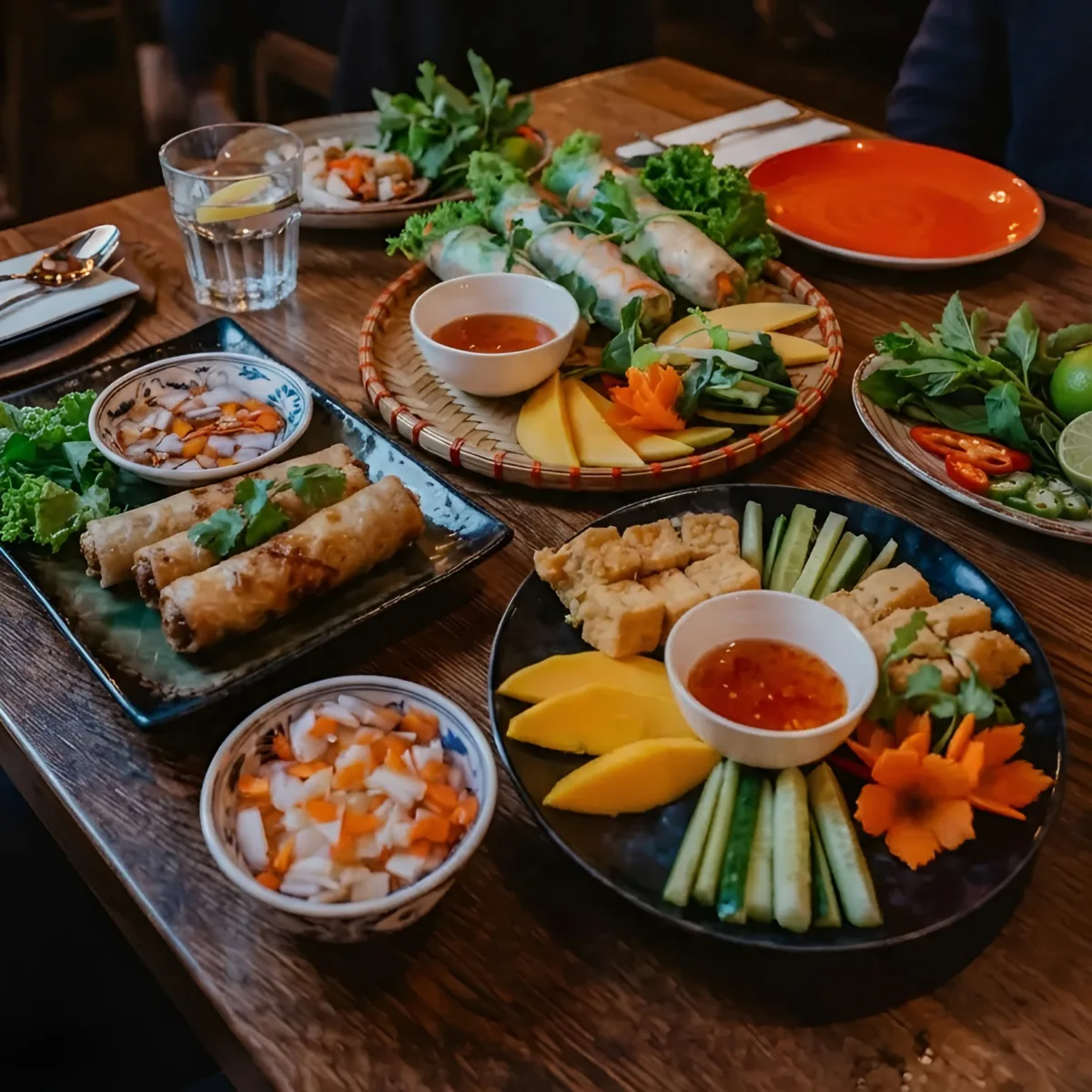
Wi-Taj’s menu includes Bún Chả with grilled pork and fresh Vietnamese herbs, Gỏi Cuốn, fresh spring rolls wrapped in rice paper, Canh Cá Chua, a sour fish soup with tomatoes and pineapple, and Thai Mango Sticky Rice with coconut milk.
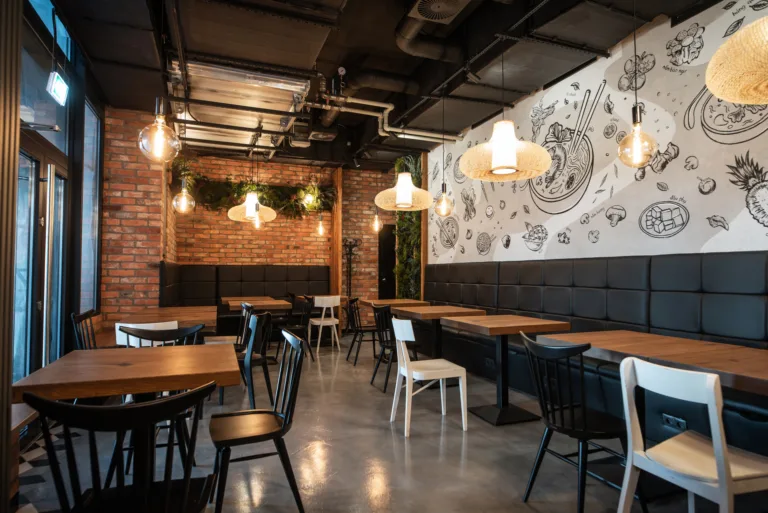
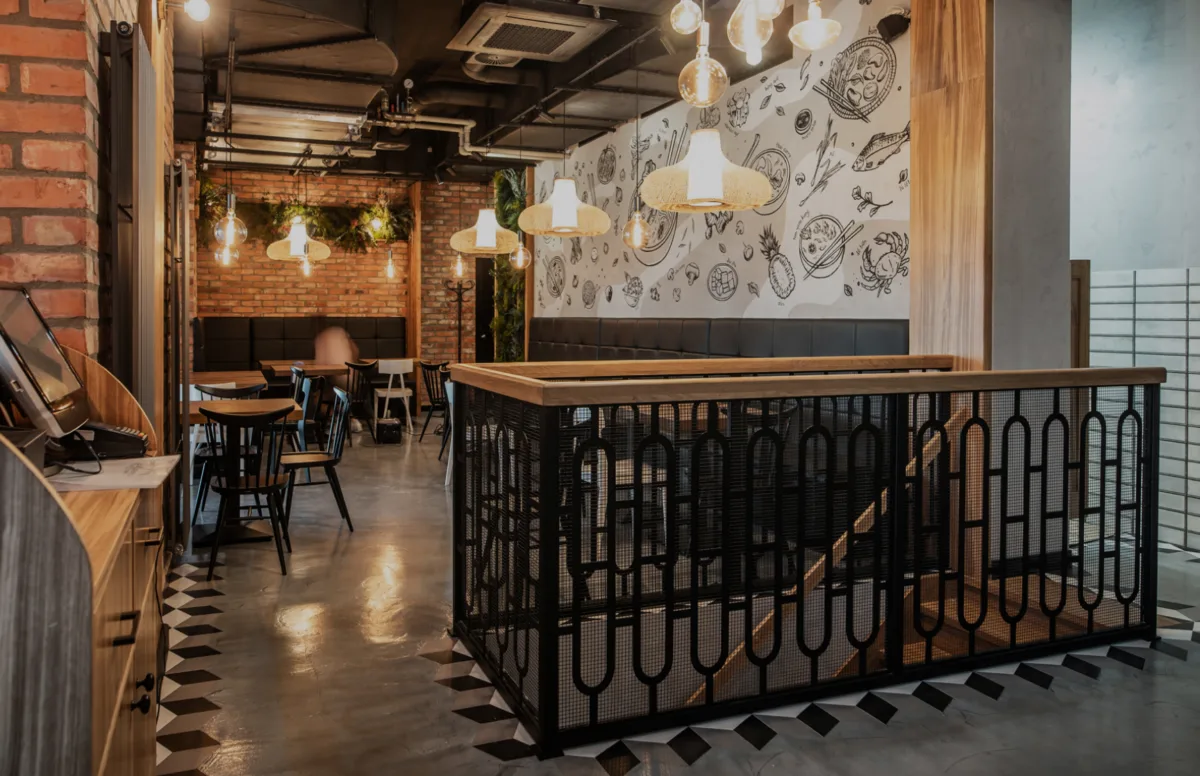
Wi-Taj at Plac Konstytucji 4 in Warsaw specializes in Vietnamese and Thai cuisine, prepared by Vietnamese chefs with respect for the flavors they themselves grew up with. So if you are not planning a flight to Hanoi or Bangkok this summer, you can always begin your culinary journey a bit closer. At the table.
Visit us and try the Asian flavors of summer in Warsaw!
Embark on a culinary journey without leaving the city. Visit the restaurant at Plac Konstytucji 4 – book a table at Wi-Taj or order Asian dishes delivered directly to your door!
Bibliography and sources
- Vietnam National Authority of Tourism, “Weather and climate in Vietnam” – characteristics of Vietnam’s regional climate.
- Vietnam Tourism, “A foodie’s guide to Vietnam’s noodles” – the custom of eating lighter bún dishes with vegetables and herbs in summer.
- Vietnam Tourism, “7 ways to enjoy Vietnam’s sidewalks” – street chè culture during heat waves and evening street eating.
- Vietnam Tourism, “A foodie’s guide to Da Nang” – kem bơ, chè, and the culinary culture of Đà Nẵng.
- Vietnam Tourism, “13 fantastic fruits of Vietnam” – Vietnamese fruits, their seasonality, and local serving methods.
- Vietnam News, “Việt Nam’s beach tourism gains momentum in summer peak season” – customs and destinations of Vietnamese domestic holiday travel.
- Vietnam News, “Phú Quốc, Đà Nẵng lead Việt Nam’s summer travel boom” – data on the popularity of summer travel in 2026.
- Tourism Authority of Thailand, “Thailand – The Perfect Year-Round Destination” – characteristics of the Thai hot season.
- Tourism Authority of Thailand, “Songkran Festival is When Family Comes First” – the family character of Songkran, returns to hometowns, and shared meals.
- TAT Newsroom, “How I Ate My Way Through Songkran” – culinary customs of Songkran and the history and preparation method of khao chae.
- The Nation, “A special treat for the tummy during the Thai summer” – history of khao chae, Mon tradition, royal cuisine, and how the dish is eaten.
- The Nation, “Som Chun: Thailand’s strangely delicious hot-season delicacy” – traditional Thai hot-season desserts, som chun, and pla haeng tangmo.
- Tourism Authority of Thailand, “Thainess you can taste – Fruit tours in the orchards of Rayong” – fruit season in Rayong and the culture of visiting orchards.
- Wi-Taj, current restaurant menu – information about Bún Chả, Gỏi Cuốn, Canh Cá Chua, and Mango Sticky Rice.