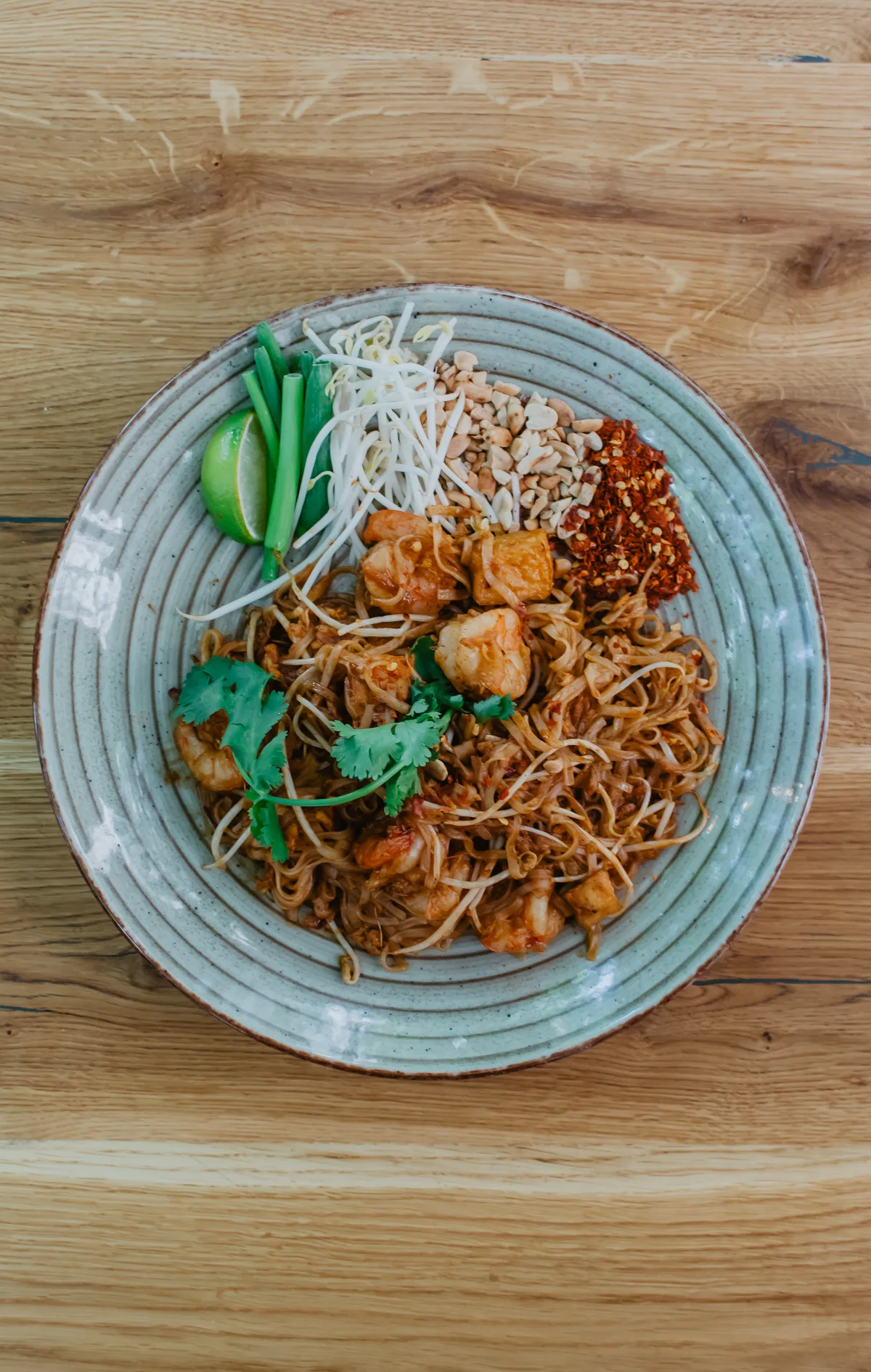
Pad Thai has a certain problem. It is probably one of the most recognizable Thai dishes in the world, and at the same time one of the most frequently misunderstood.
Outside Thailand, one can encounter Pad Thai with ketchup, sweet chili sauce, carrots, bell peppers, broccoli, large amounts of sugar, and even tomato sauce. Sometimes this produces a very tasty stir-fried noodle dish. Just not necessarily Pad Thai. Good Pad Thai is far more subtle. It should be neither very sweet nor very sour, nor drowned in sauce. The noodles should remain springy, the ingredients should be perceptible individually, and the sauce is based primarily on an extremely simple balance:
- tamarind provides sourness,
- fish sauce provides saltiness and umami,
- palm sugar provides sweetness.
Add to this rice noodles, egg, tofu, mung bean sprouts, garlic chives, peanuts, often dried shrimp and fresh shrimp. Sounds simple. And that is precisely why Pad Thai is difficult. You cannot hide mistakes under a heavy curry or large amounts of sauce. A few ingredients must be prepared properly and meet in the wok at exactly the right moment. But the most surprising thing is the history of this dish. Because Pad Thai is not an ancient recipe passed down in Thai families for a thousand years. This dish is much younger than many people who prepare it today.
Did the Prime Minister of Thailand really invent Pad Thai?
This is one of the most frequently repeated stories about Thai cuisine. In the 1930s and 1940s, Prime Minister Plaek Phibunsongkhram, called Phibun, supposedly created Pad Thai as Thailand’s new national dish. The story is great. The problem is that it is too simple.
Contemporary historical research shows a more interesting picture. Pad Thai did not suddenly appear as a completely new dish invented by one politician. The technique of stir-frying noodles and rice noodles themselves were strongly associated with Chinese, particularly Teochew, culinary traditions present in Siam long before.
The Thai term ก๋วยเตี๋ยว, kuai tiao, meaning noodles, has Chinese origins. Similar words can be found today in other Southeast Asian countries. Vietnam has hủ tiếu, and Malaysia and Singapore have kway teow.
Pad Thai therefore belongs to a much larger history of migration of people, products, and culinary techniques in Asia. A study published in 2024 in the academic journal “National Identities” describes Pad Thai precisely as the result of “Thai-ization” of Chinese kway teow, that is, the transformation of a previously known technique into a dish with a distinctly Thai character.
So what did Phibun do?
He did not need to invent Pad Thai to completely change its history. Phibun’s government actively promoted eating noodles during an intense period of building modern Thai national identity.
This was a period of enormous change. In 1939, Siam officially became Thailand. The state conducted campaigns aimed at modernizing citizens’ daily lives, creating a sense of common identity, and emphasizing everything that was to be “Thai.” Food also became part of this project.
At the same time, during World War II, problems arose with rice availability and prices. Promoting noodles made additional economic sense, as a given amount of rice could produce more noodles than cooked rice. The government therefore promoted the consumption of noodle dishes and the business of noodle sellers. It was in this environment that pad Thai became incredibly popular and became a dish associated with modern Thailand.
Interestingly, Thai PBS, analyzing preserved government recipes from that period, notes that there is no basis for simply stating that one of Phibun’s recipes was today’s Pad Thai. Similarities are visible, but culinary history was more gradual evolution than a moment when the prime minister sat at his desk and wrote a recipe.
Therefore, it is most honest to say: Phibun probably did not “invent” Pad Thai from scratch. However, his government played an enormous role in creating the conditions through which the dish became a national symbol. And the story does not end there.
Why is it actually called Pad Thai?
The name is very literal. Phat or pad means frying, usually quick stir-frying by mixing ingredients. Thai means Thai.
The longer historical name was kuai tiao pad thai, or roughly “noodles fried Thai-style.” Over time, the first part began to disappear. What remained: Pad Thai.
The name itself is therefore remarkable. After all, in Thailand one does not speak of “Thai green curry” or “Thai tom yum soup.” The word “Thai” in the name suggests that someone once very consciously wanted to distinguish this version of fried noodles from its Chinese roots. This is a small linguistic trace of the history of the entire country.
What actually makes Pad Thai Pad Thai?
If one had to identify the heart of the entire dish, it would not be the shrimp. Not the egg. Not even the noodles. It would be the sauce. Classic Pad Thai sauce can be built from practically three basic flavors: sour, salty, and sweet. In a good traditional recipe, these are provided by: tamarind + fish sauce + palm sugar. Precisely this trio as the foundation of traditional Pad Thai is indicated by both Thai culinary studies and contemporary recipes by Thai chefs.
Tamarind: An ingredient not worth skipping
If someone wants to make really good Pad Thai at home, there is one product worth seeking out in an Asian store: tamarind paste or pulp.
It gives the dish its characteristic fruity sourness. The lime served on the plate does not perform exactly the same function. Lime sourness is fresh, sharp, and citrusy. Tamarind is darker, more complex, slightly caramelized and fruity.
Thai cook and author Pailin Chongchitnant points out another detail: ready-made tamarind concentrates can vary greatly in strength. Thai products are usually liquid, brown pulps, while some Indian concentrates are much more concentrated. Substituting one for the other in a 1:1 ratio can completely ruin the dish.
Palm sugar
The second ingredient is sugar. But traditionally, it’s not white crystal. Palm sugar is used, among other things, in Thai cuisine. Its flavor is more caramelly and complex than regular white sugar. However, this doesn’t mean that a good pad Thai should be sweet. The sweetness should be balanced by tamarind and fish sauce (and if you want to learn about other sweet traditions in the region, check out our article on Vietnamese and Thai desserts). If the first taste you experience after popping the noodles into your mouth is sugar, the proportions have probably gone too far.
Fish sauce
The third pillar is nam pla, Thai fish sauce. It provides salt and umami. In well-prepared Pad Thai, however, it should not smell intensely of fish. It should connect the remaining ingredients. And here appears the secret of all Thai cuisine: it is not about finding one dominant flavor, but about balancing several flavors at once.
And where is the ketchup?
This is one of the most frequently asked questions. In the classic Pad Thai sauce base, ketchup is not needed. An authentic recipe can achieve its brownish-orange color from tamarind, caramelized sugar, chili, or fat and shrimp components.
Pailin Chongchitnant builds her classic recipe from tamarind, palm sugar, and fish sauce, without ketchup. This does not mean that every Pad Thai containing ketchup is automatically a culinary crime. Cuisine changes. The problem begins when sweet red sauce replaces the balance of tamarind, fish sauce, and sugar. A completely different flavor profile then emerges.
Sen Chan: Noodles matter more than it seems
In good Pad Thai, the noodles cannot be random. One of the most characteristic varieties is sen chan, thin rice strands associated with Chanthaburi province. This is precisely why one can encounter the name Pad Thai Sen Chan.
Sen chan absorb sauce well, but when properly prepared, they retain springiness. Thai PBS even devoted a separate feature to factories producing traditional sen chan in Chanthaburi and their particular connection to Pad Thai.
Here appears one of the most important rules for preparing Pad Thai at home: the noodles are usually not cooked beforehand to full softness. They are soaked. Then they finish cooking in the wok, absorbing the sauce and a small amount of liquid. If we throw already fully cooked strands into the wok, after a moment we may get a sweet-sour mush.
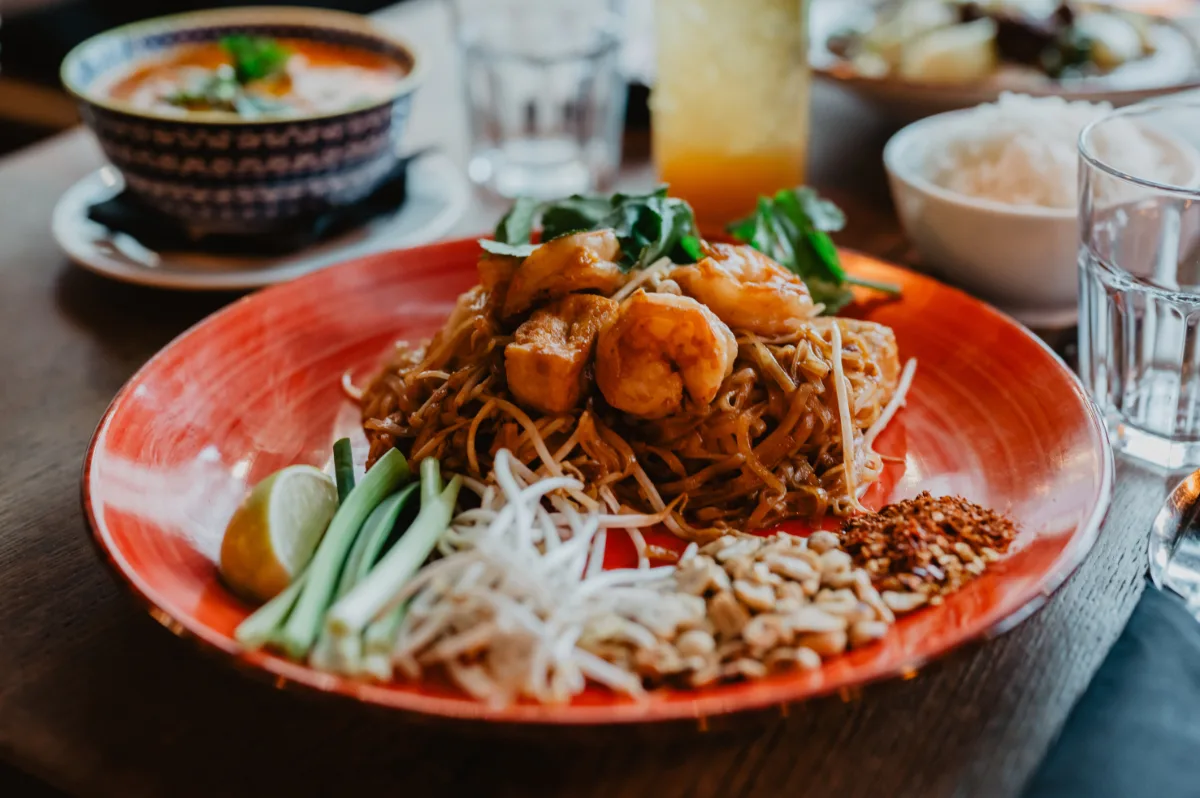
What does classic Pad Thai look like?
There is no single recipe mandatory throughout Thailand, but the classic set of ingredients is quite characteristic. In addition to noodles and sauce, we often find:
- egg,
- firm tofu,
- dried shrimp,
- fresh shrimp,
- sweet preserved radish,
- shallot or garlic,
- mung bean sprouts,
- garlic chives,
- roasted peanuts,
- dried chili.
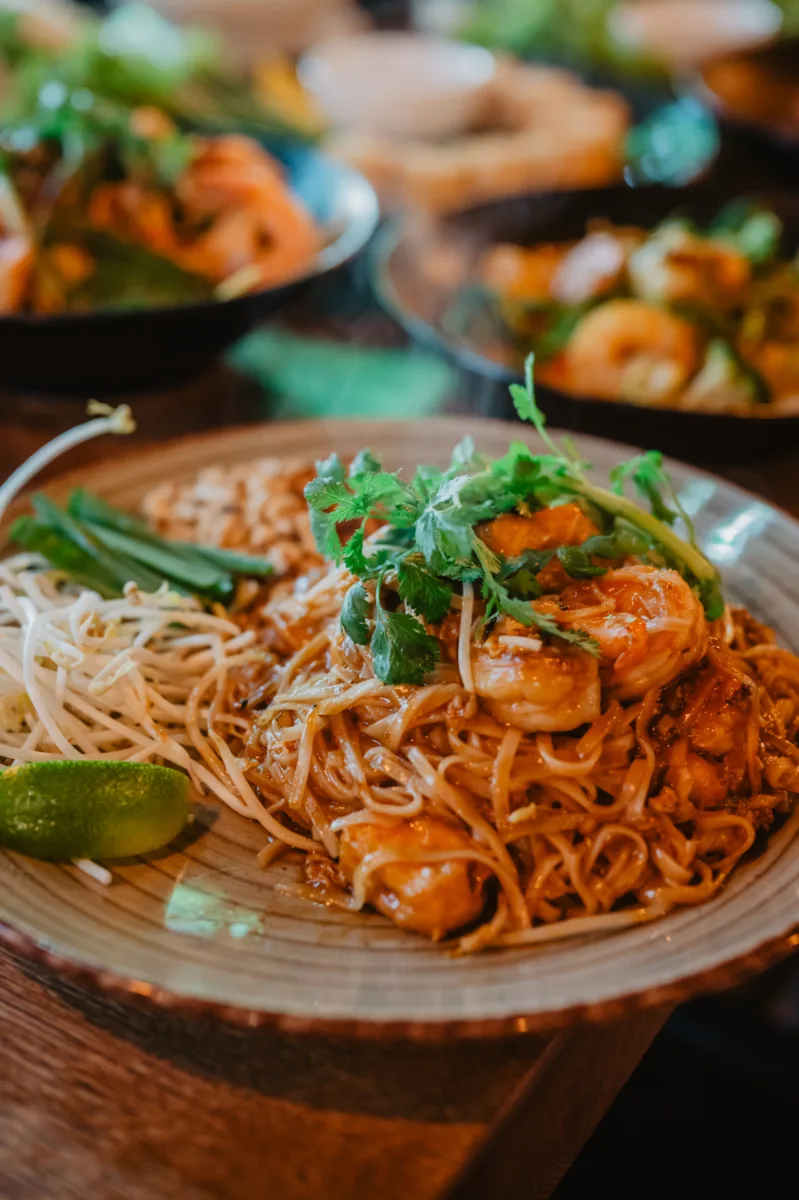
Lime and additional sprouts, chives, and chili appear on the table. A Tourism Authority of Thailand document describing culinary heritage lists Pad Thai prepared precisely with tofu, dried shrimp, egg, peanuts, sprouts, chives, fish sauce, tamarind, chili, and garlic.
Interestingly, in Thailand the version with shrimp is far more classic than the chicken Pad Thai popular in Europe. Pailin Chongchitnant even notes that standard Pad Thai in Thailand is associated precisely with shrimp, though of course today it can also be prepared with other protein.
The biggest mistake when preparing Pad Thai? Too much of everything at once
Pad Thai is a street food dish. A good vendor can prepare a portion in a few minutes. But before the wok goes over the fire, almost everything is already ready:
- The sauce sits nearby.
- The tofu is cut.
- The nuts are roasted.
- The noodles are soaked.
- The sprouts are washed.
- The chives are cut.
- The shrimp are prepared.
This is very important, because after heating the wok there is no longer time to search for fish sauce in the cupboard. The frying itself is quick. Preparing the ingredients takes much longer.
Why is street Pad Thai hard to replicate at home?
The answer lies beneath the wok. Fire. Professional restaurant burners reach temperatures much higher than an ordinary home stove. On the street, the cook can very quickly evaporate water and concentrate the sauce while maintaining the springiness of the noodles.
Therefore, one of the most common home mistakes is attempting to prepare four or six portions simultaneously in a large pan. The temperature drops sharply. Ingredients begin to steam instead of fry. The noodles spend too long in liquid. The result? Gluey Pad Thai.
At home, it is much better to prepare one or two portions at a time. This is one of those cases where a smaller pan and less food can give a better result.
Pad Thai should not swim in sauce
This is another thing easily noticed in Thailand. Good Pad Thai is rather a dry stir-fried noodle, not noodles in sauce. The sauce should be practically completely absorbed by the strands. The surface may be slightly glossy, but there should not be a pool of sweet sauce remaining at the bottom of the plate. The technique therefore looks roughly like this:
- first aromatics and additions,
- then noodles,
- then sauce and a small amount of liquid,
- the noodles soften and absorb flavor,
- then egg,
- finally fresh sprouts and chives.
Everything happens quickly.
Egg can be prepared in several ways
The most basic method involves pushing the noodles to the side of the wok, cracking the egg, and partially setting it before combining with the noodles. But there are also more spectacular versions. In Bangkok, Pad Thai wrapped in a thin layer of egg, resembling a very delicate omelet, has gained popularity. The egg then becomes not so much one of the ingredients as the wrapping of the entire dish. This is a good example of how a street dish can be developed into something much more impressive without completely changing its character.
Pad Thai does not taste the same everywhere: Regional varieties
One of the biggest pitfalls when discussing Thai cuisine is treating it as one uniform tradition. Thailand has very strong regional cuisines. This also applies to stir-fried noodles. Thai PBS notes that under the name Pad Thai one can find local variations differing even quite significantly from the version best known from Bangkok.
Chanthaburi: Crab, pineapple, and sen chan
Chanthaburi in eastern Thailand is particularly strongly associated with sen chan noodles. Local variants may use seafood, including crab, as well as pineapple. The Thailand Foundation describes an even more interesting eastern version in which blue crab meat and bacon are cooked for a long time with aromatic paste and tamarind, sugar, and fish sauce.
Only then is sen chan fried in the prepared sauce. The result is a dish more intense, darker, and decidedly different from the average tourist Pad Thai from Bangkok.
Ang Thong: Green mango
Thai PBS also gives the example of Ang Thong province, where Pad Thai may be finished with sour, unripe mango. This makes a lot of sense from the perspective of Thai cuisine. Sour green mango can perform a similar function to lime: it cuts through the sweetness and richness of the dish.
The North: Different noodle strands
In northern variants, one can encounter the use of noodles associated with khao soi, which shows that the shape and structure of the strand also undergo regional changes.
And what is Pad Mee Korat?
If we want to truly understand the history of Pad Thai, it is worth traveling culinarily even further northeast, to Nakhon Ratchasima, commonly called Korat. There, one of the local symbols is Pad Mee Korat.
At first glance, it resembles Pad Thai. We have rice noodles, a sour-salty-sweet sauce, sprouts, and chives. But the character of the dish is different. Pad Mee Korat can be stronger, more spicy, and less focused on peanuts and additions typical of central Pad Thai.
Most interestingly, there is a hypothesis that precisely earlier Thai stir-fried noodles such as Pad Mee Korat may have been one of the culinary branches that influenced the development of Pad Thai. The Thailand Foundation indicates this possibility in its study of the dish’s history.
Instead of asking: “Who invented Pad Thai?” it is more interesting to ask: “How did Chinese noodles, local Thai noodles, tamarind, fish sauce, migrations, and 20th-century politics meet in one wok?” This is much closer to the true history.
Do Thais really eat a lot of Pad Thai?
Yes. But not necessarily as much as a tourist might imagine. The Michelin Guide notes an interesting paradox: for many people in the world, Pad Thai is their first contact with Thai cuisine, while in Thailand itself it is not at all the most popular noodle dish. The Thai repertoire is enormous:
- Boat noodles
- Guay tiew tom yum
- Rad na
- Pad see ew
- Khao soi
- Yen ta fo
- Pad mee Korat
And dozens of regional dishes that the average European guest has never heard of. Therefore, for a Thai person, Pad Thai may simply be one of many dishes. For a resident of Warsaw, London, or New York, however, it has become a symbol of the entire country.
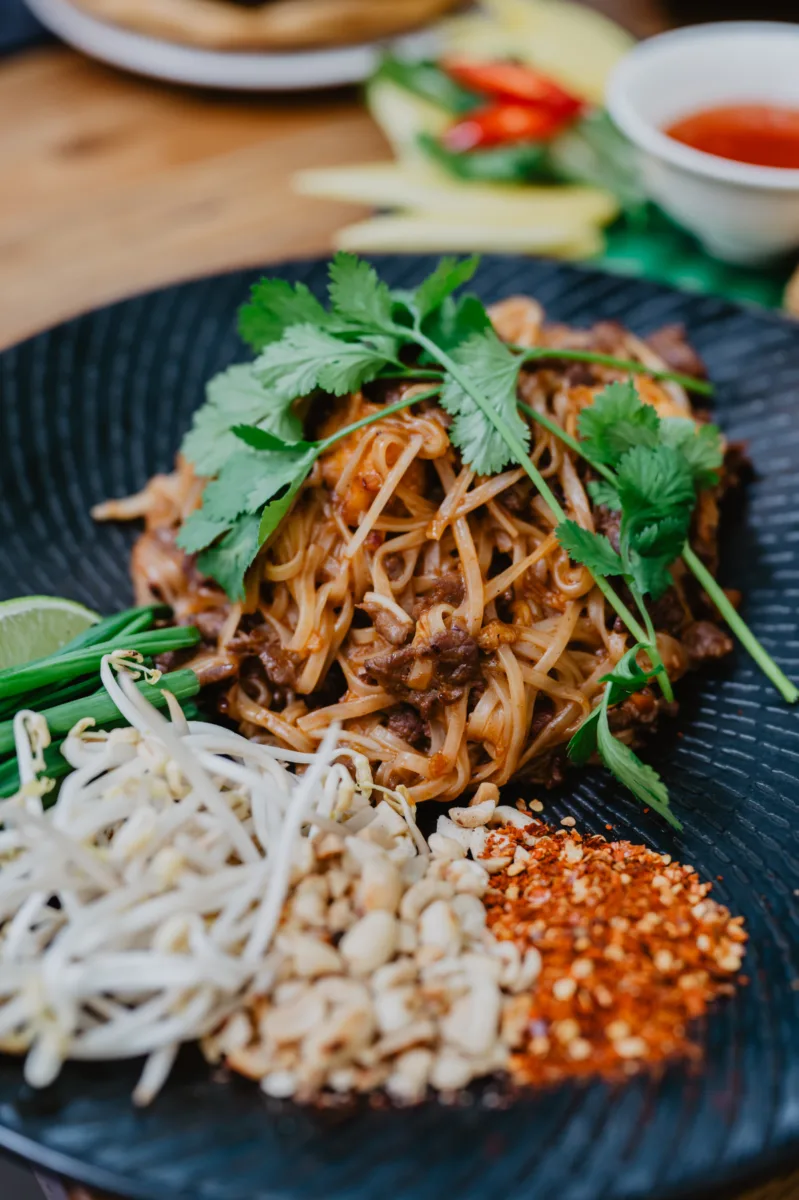
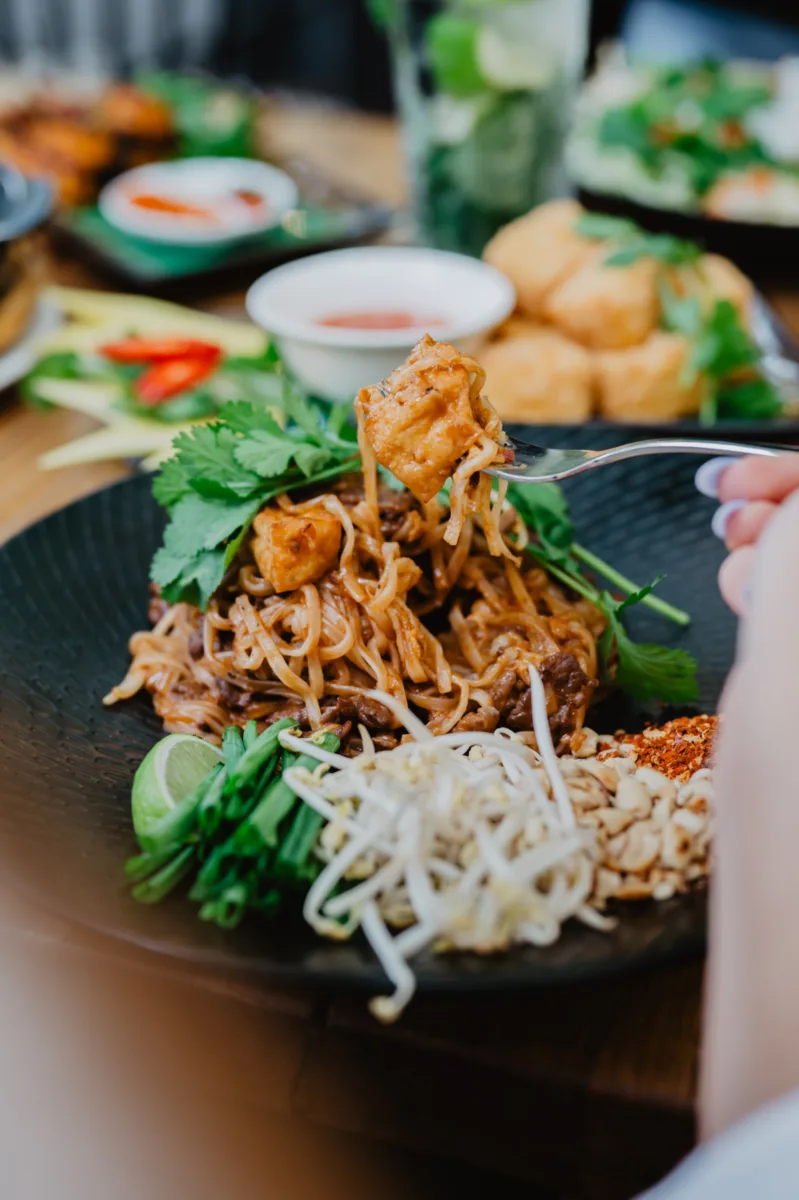
How did Pad Thai conquer the world?
Here the story comes full circle. In the first half of the 20th century, Thai authorities helped build the position of Pad Thai within the country. Several decades later, Thailand began consciously promoting all Thai cuisine worldwide.
Programs such as Thai Kitchen to the World supported the development of Thai restaurants abroad, the export of ingredients, and building Thailand’s image through gastronomy. The Thai Ministry of Foreign Affairs still indicates the development of restaurants and authentic Thai cuisine as an element of the country’s international promotion.
The effect is remarkable. Thailand is today one of those countries whose cuisine can be found in practically every major European city. And Pad Thai plays the role of the perfect “entry dish” in this export.
- It is not extremely spicy.
- It has a form of noodles familiar to Europeans.
- It is sweet, sour, and salty.
- It can be prepared with shrimp, chicken, tofu, or another addition.
So, it’s exotic enough to evoke Thailand, yet approachable enough for someone who’s never had Thai food before to try. Looking for other refreshing options for warm days? Check out our guide to summer food in Vietnam and Thailand.
The Pad Thai market in 2026: From street food to global gastronomy
Currently, Pad Thai functions simultaneously in several completely different worlds. In Thailand, one can still eat it from a wok in a small street establishment. One can encounter restaurants specializing almost exclusively in Pad Thai. One can find premium versions with large shrimp, crab meat, or egg surrounding the noodles. One can also order a reinterpretation in a modern Thai cuisine restaurant.
Outside Thailand, the dish has become one of the foundations of Thai restaurant menus. The scale of the entire Thai cuisine market is very large. In August 2026, the official Thai SELECT system, operated by the Thai Ministry of Commerce and certifying restaurants offering authentic Thai cuisine, includes 1,956 restaurants in 73 countries.
The Thai government still treats gastronomy as part of its international “soft power.” In 2026, authorities again announced the development of Thai brands and restaurants in the European market, while noting the problem of establishments where the flavors of Thai dishes are very heavily modified to local tastes. And precisely Pad Thai illustrates this tension well. Authenticity or localization? Is Pad Thai with beef still Pad Thai? And with chicken? And tofu? What about Pad Thai without fish sauce for vegans? What about a version without peanuts for someone with allergies?
Cuisine has never been static. Pad Thai itself was created through adaptation of earlier traditions. Therefore, authenticity need not mean museum recreation of one recipe. However, there is a difference between adapting a dish and removing elements that build its character. If we change shrimp to tofu, we can still preserve the flavor of Pad Thai. If we remove tamarind, fish sauce, and palm sugar and replace them with ketchup and sweet chili, we are already changing the very heart of the dish.
How to make good Pad Thai at home?
The following recipe was developed based on the classic recipe by Pailin Chongchitnant, a Thai culinary author and creator of Hot Thai Kitchen, specializing in explaining traditional Thai cooking techniques. The original recipe uses tamarind, palm sugar, fish sauce, sen lek, tofu, dried shrimp, preserved radish, shrimp, eggs, sprouts, and garlic chives, among other ingredients. We simplify our version slightly so that it can be executed without problems in a Polish kitchen, but we preserve the elements responsible for the characteristic flavor.
Homemade Pad Thai with shrimp, 2 servings
Ingredients
Sauce:
- approximately 35 g palm sugar or light brown sugar,
- 3 tablespoons water,
- 3 tablespoons Thai tamarind pulp, a bit more if needed,
- 2 tablespoons good-quality fish sauce.
Pad Thai:
- approximately 115 g dry, medium-width rice noodles,
- 8–10 peeled shrimp,
- approximately 80 g firm tofu,
- 2 eggs,
- 2–3 tablespoons neutral-flavored oil,
- 2 cloves garlic,
- 1 small shallot,
- large handful of mung bean sprouts,
- several stalks of garlic chives or regular chives,
- approximately 30 g roasted peanuts,
- chili flakes to taste,
- 1 lime.
If you find in an Asian store:
- dried shrimp,
- sweet Thai preserved radish.
They are not necessary for executing the simpler home version, but they make the flavor much closer to traditional Pad Thai.
Step 1: Do not cook the noodles
This is the most important rule. Place the rice noodles in room-temperature water and soak according to their thickness until they become pliable but remain clearly undercooked. For medium strands, this may take approximately 45–60 minutes. Then drain them thoroughly. The noodles will finish cooking only in the wok.
Step 2: Prepare the sauce
Finely chop the palm sugar. Put it in a small pot and heat until it begins to melt. Allow it to caramelize slightly. Add water, then tamarind and fish sauce. Heat briefly until the ingredients combine. Taste. The sauce should be strong. Sour. Salty. Sweet. Do not judge it yet as if it were a finished dipping sauce. After spreading over the noodles, its flavor will be much milder. And remember: tamarinds vary in sourness. If your product is extremely sour, start with a smaller amount.
Step 3: Prepare everything before heating the pan
Cut the tofu into small cubes. Chop the garlic and shallot. Cut the chives. Chop the peanuts. Prepare the eggs and shrimp. Place the sauce by the stove. From this moment, everything will happen quickly.
Step 4: Heat the wok very hot
Add oil. Add tofu, shallot, and garlic. If using dried shrimp and preserved radish, add them as well. Fry briefly until a distinct aroma appears. Add fresh shrimp and sear them. Do not overcook them. If they are almost done, you can remove them from the wok for a moment and add them again at the end.
Step 5: Now the noodles
Add the drained noodles and prepared sauce. Fry and toss. The noodles will begin to absorb the liquid. If the sauce has evaporated and the strands are still too hard, add a little water, not another portion of sauce. This is an important difference. More sauce means more sugar, salt, and acid. Water only allows the noodles to finish cooking.
Step 6: Egg
Push the noodles to one side of the wok. Add a little oil to the free space and crack two eggs. Let them begin to set. Only then break them up with a spatula and combine with the noodles. This way, in the finished dish you will see fragments of egg instead of a uniform egg coating covering everything.
Step 7: Vegetables at the very end
Add mung bean sprouts and chives. Fry very briefly. They should heat up but still remain crisp. Add the shrimp again if they were removed earlier. Done.
How to serve Pad Thai?
Add crushed, roasted peanuts on top. Place a lime wedge alongside.
You can also serve:
- fresh sprouts,
- garlic chives,
- dried chili,
- additional peanuts.
In Thailand, the final seasoning of the dish is often left partially to the person eating. Someone will add more chili. Someone will squeeze more lime over the noodles. Someone else will eat it without changes. This is another element of Thai table culture, in which seasoning dishes does not always end in the kitchen.
Five rules for homemade Pad Thai that make the biggest difference
- Use tamarind. Lime will not replace its deep, fruity sourness.
- Do not overcook the noodles before frying. They should finish cooking in the wok.
- Prepare a maximum of two servings at once. Too many ingredients will lower the pan temperature.
- Do not drown the noodles in sauce. Finished Pad Thai should be stir-fried and relatively dry.
- Do not try to make it “more Thai” by adding ten sauces. The most important are three flavors: tamarind, fish sauce, and palm sugar.
Why is Pad Thai such a good example of Thai cuisine?
Not because Thais eat it every day. They do not. Not because it is the oldest Thai dish. It is not. Pad Thai is interesting because in one serving one can see almost the entire history of modern Thailand:
- There are Chinese noodles that arrived with migration.
- There are Thai ingredients giving it a new identity.
- There are tamarind, fish sauce, and palm sugar.
- There is the influence of local regional cuisines.
- There is the politics of nation-building in the 20th century.
- There is street food culture.
- There is the later promotion of Thai cuisine worldwide.
- And there is contemporary globalization, thanks to which today one can order Pad Thai in Warsaw, Paris, New York, or Sydney.
Few dishes tell a country’s story as well as neighboring Vietnam, where coffee has become a national symbol.
Pad Thai at Wi-Taj
At Wi-Taj, Pad Thai is a classic Thai dish on the Wi-Taj menu. We prepare it with rice noodles, egg, tofu, sprouts, tamarind, and peanuts, and guests can choose a version with Black Tiger shrimp, beef, chicken, or tofu. And that’s the beauty of Pad Thai. You can read its history. You can learn the proportions. You can make it yourself at home. But in the end, everything is decided in a few minutes over a very hot wok. Because Pad Thai isn’t primarily a sauce or a list of ingredients. Pad Thai is a technique.
Craving iconic fried noodles straight from the wok?
Book a table at Wi-Taj at Plac Konstytucji 4 or order authentic Pad Thai with home delivery in Warsaw.
Bibliography and sources
- Yao Yao, Baoyun Yang, Xinxin Wang, “Pad Thai: the Thai-ization of Chinese food and the Thai nationalism project by the Phibunsongkhram government”, National Identities, 2024. Academic study on the Chinese roots of the dish, the Thai-ization process, and the connection of Pad Thai with the national politics of Phibunsongkhram’s government.
- Thai PBS NOW, materials on the history of Pad Thai and recipes from the Phibunsongkhram period. A particularly important source for distinguishing between state promotion of the dish and the popular legend of its direct “invention” by the Prime Minister.
- Thai PBS, “ผัดไทย เมนูโดนใจทั่วโลก”. Material on the history, definition, and regional variants of Pad Thai, including versions from Chanthaburi, Ang Thong, and northern Thailand.
- Thailand Foundation, “Pad Thai: Love, to the Noodles of Thailand”. Study on etymology, Chinese influences, connection to Pad Mee Korat, traditional sauce, and regional versions from Thailand’s eastern coast.
- Michelin Guide, “Use Your Noodle: A Primer on Thai Noodles”. Context on Pad Thai’s contemporary position in Thailand and its unique recognition among international audiences.
- Pailin Chongchitnant, Hot Thai Kitchen, “Authentic Pad Thai Recipe”. Detailed Thai recipe and preparation technique used as the basis for the home recipe in the article.
- Tourism Authority of Thailand / ASEAN World Class Culinary Heritage Cities. Description of classic Pad Thai ingredients and its place in Thai culinary heritage.
- Thai PBS, material on Sen Chan in Chanthaburi Province. Source on traditional noodle strands strongly associated with Pad Thai preparation.
- Ministry of Foreign Affairs of Thailand, “Thai Kitchen to the World”. Information on state promotion of Thai cuisine, product exports, and development of Thai restaurants worldwide.
- Thai SELECT, Ministry of Commerce, Royal Thai Government. Current data from 2026 on the authentic Thai cuisine certification program: 1,956 restaurants in 73 countries.
- Royal Thai Government, 2026. Materials on further expansion of Thai cuisine in Europe and the use of cuisine as an element of Thai soft power.
- Wi-Taj, current restaurant menu, August 2026. Information on Pad Thai served at Wi-Taj and available variants of the dish.