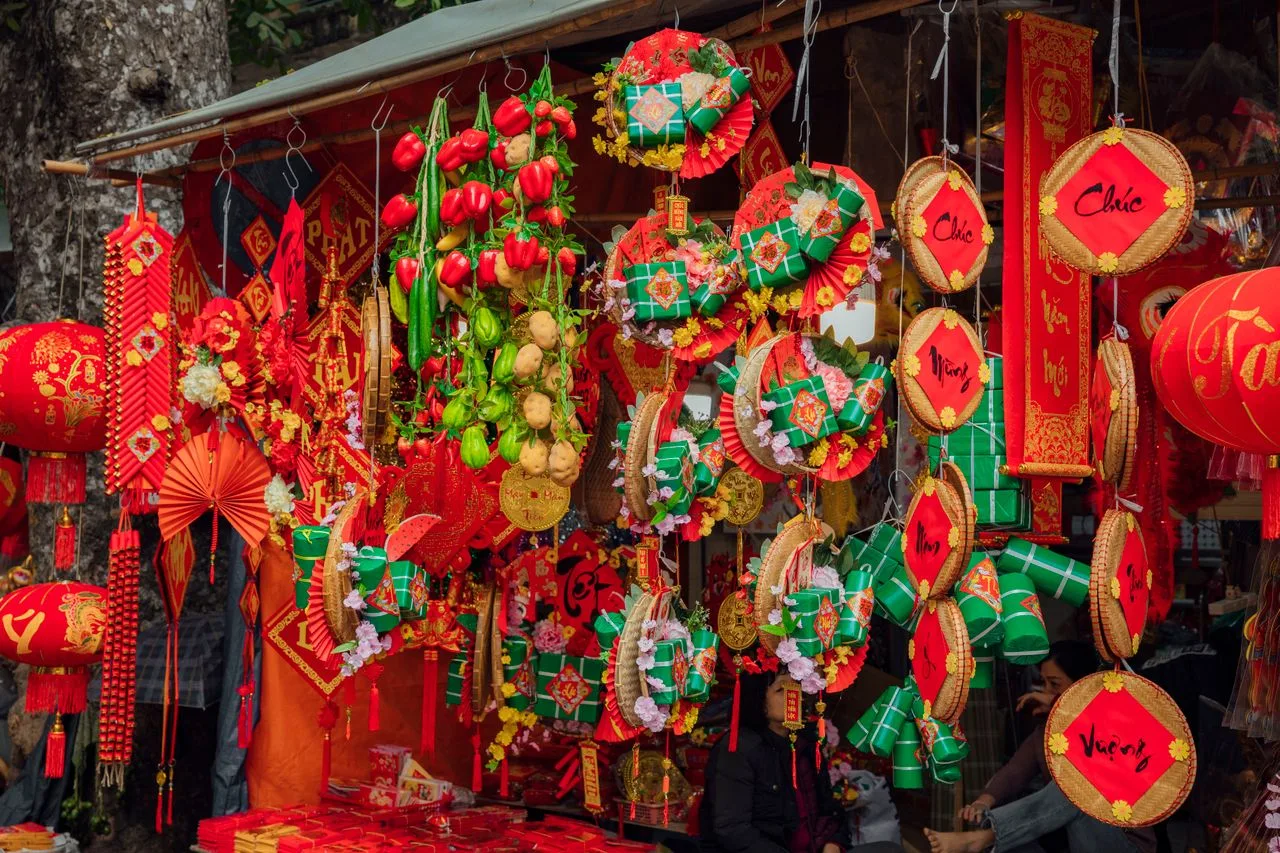
At the end of September, something hard to miss begins to happen in Vietnam. Bakery stalls lined with decorative boxes line the streets. Red lanterns begin to glow. Paper masks, lions, carp, and the distinctive five-branched lanterns appear in the shops. In the evenings, the rhythmic beating of drums becomes increasingly common somewhere between the houses. And then comes the night of the full moon. It’s Tết Trung Thu, the Vietnamese Mid-Autumn Festival, one of Vietnam’s most distinctive traditional holidays.
For adults, it is an opportunity to meet with family, reminisce about childhood, make offerings to ancestors, and share food. For children, it means something entirely different: lanterns, processions, sweets, drums, múa lân, and the anticipated moment called phá cỗ, when they can finally get to the previously prepared table full of fruits and bánh Trung Thu.
And for anyone interested in Vietnamese cuisine, Tết Trung Thu is fascinating for another reason: it’s a celebration where food isn’t just about food. Every round shape, fruit, cookie, and even the way the Trung Thu bánh is shared tells a story about family, nature, harvests, and the Vietnamese understanding of community.
When does Tết Trung Thu fall in 2026?
Tet Trung Thu doesn’t have a fixed date in the Gregorian calendar. It is celebrated on the 15th day of the eighth lunar month, during the full moon. In 2026, Tet Trung Thu falls on Friday, September 25th. In the lunar calendar, it will be the 15th day of the eighth month. Therefore, sometimes the holiday falls in September, other times in early October.
In Vietnamese, other terms can also be encountered:
- Tết Trông Trăng, or the Moon-Watching Festival,
- Tết Thiếu Nhi or Tết Trẻ Con, or the children’s festival,
- as well as terms emphasizing the family gathering and the full moon.
And each of them reveals a slightly different layer of the same festival.
Before Tết Trung Thu became a children’s festival, it was a festival of nature
Modern Vietnam associates Trung Thu primarily with children. But the original meaning of the holiday was likely much more connected to agriculture. This is an important detail, as Vietnam was for centuries a society based on rice cultivation and the rhythm of the seasons.
Materials prepared by the Hội An Center for Cultural Heritage Management and Preservation indicate that the Rằm tháng Tám festival was associated with a moment in the agricultural season, observing the moon, and wishes for prosperity for future harvests.
Moon observation was even believed to help ancient inhabitants predict the weather and conditions for the upcoming agricultural season. Trung Thu, therefore, was, in a sense, a moment of pause. Part of the intensive field work ended. People could sit together, gaze at the moon, prepare food, and celebrate. Over time, the holiday acquired many other meanings. Ancestor worship, family gatherings, legends related to the moon, and, above all, the incredibly strong tradition of children’s festivals joined the agricultural symbolism.
This is not simply a “Chinese festival transplanted to Vietnam”
Festivals associated with the full moon of the eighth lunar month are found in many East and Southeast Asian cultures. Chinese influences on the Vietnamese Trung Thu are obvious, especially in the case of mooncakes. But over hundreds of years, Vietnam has developed its own rituals, legends, toys, table decorations, and celebrations.
Hội An is a good example. Official documentation of its heritage describes Trung Thu as a tradition that arose from the fusion of local Vietnamese culture with Chinese and Japanese influences that have converged over the centuries in the commercial hub of Hội An. This is why Vietnamese Trung Thu is best experienced not as a copy of another Asian festival, but as a distinct element of Vietnamese culture.
Why is Tết Trung Thu today primarily a children’s festival?
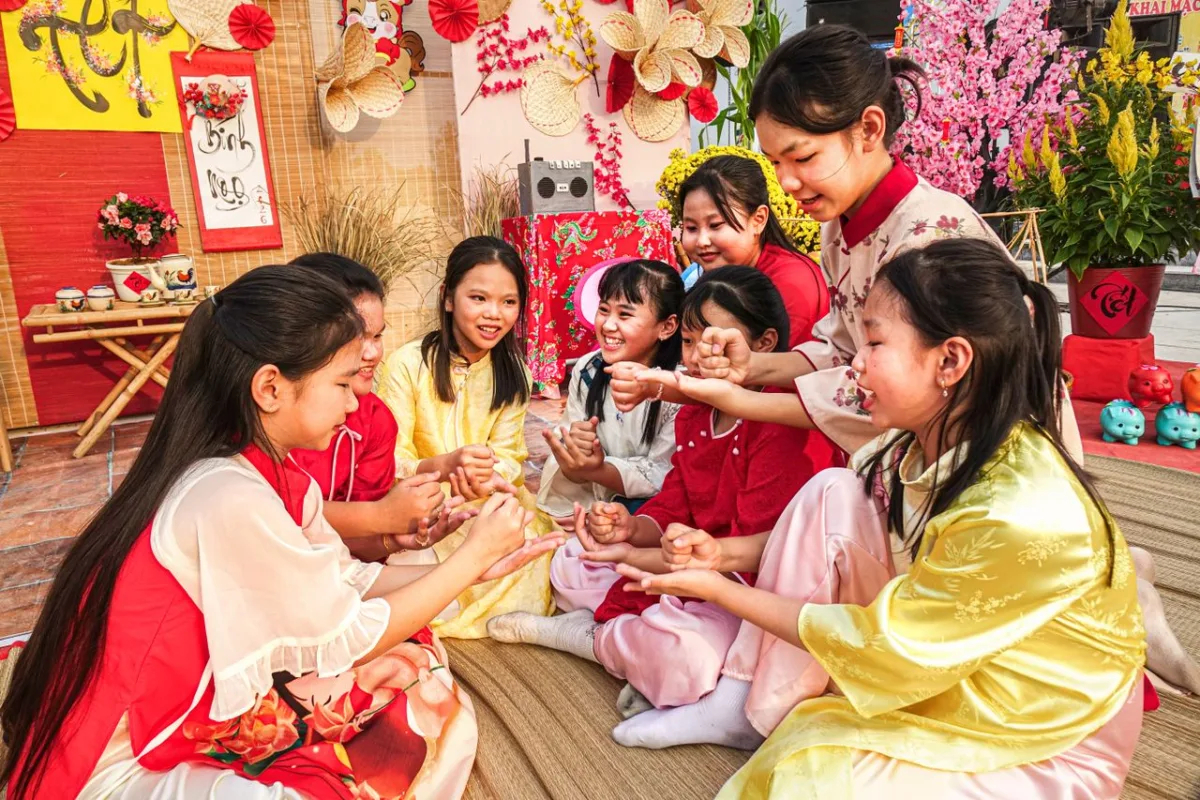
This is perhaps the most distinctive feature of Vietnamese Trung Thu. In the evening, the streets don’t belong to adults. They belong to children. Children receive lanterns, wear masks, walk in processions, watch múa lân, sing songs, and wait for sweets and Trung Thu banh. Vietnam Tourism calls Tết Trung Thu simply the Children’s Festival.
Vietnam has an interesting, relatively contemporary layer to this tradition. After gaining independence in 1945, Hồ Chí Minh addressed special letters to Vietnamese children during Trung Thu.
The first independent Trung Thu in 1945 thus began to take on additional significance as a celebration for the country’s youngest generation. For several generations of Vietnamese, Trung Thu has thus become one of their strongest childhood memories.
It is not just about the cake itself. It is about the moment when parents bought a lantern. About running in the evening with other children. About the sound of drums coming from the end of the street. And about waiting until the adults finally say that phá cỗ can begin.
What exactly does a Vietnamese family do during Tết Trung Thu?
There is no single mandatory scenario. Trung Thu looks different in central Hanoi, different in a small town, different in Hội An, and different still in a modern family living in a high-rise in Ho Chi Minh City.
However, several recurring elements can be identified:
- Before the festival, bánh Trung Thu is purchased.
- Families prepare fruits and sweets.
- In more traditional homes, mâm cỗ Trung Thu appears, a specially prepared food composition.
- Some families place dishes on the ancestral altar.
- Children receive lanterns.
- In the evening, people go out to watch processions and múa lân.
- And when the moon is high, the family sits together, cuts bánh Trung Thu into pieces, drinks tea, eats fruit, and phá cỗ begins.
“Phá cỗ” sounds innocent, but children wait precisely for this moment
It’s difficult to translate this expression literally into English. Cỗ means a prepared feast or ceremonial table of food. Phá means, among other things, breaking, dismantling, or disturbing something. In practice, phá cỗ Trung Thu refers to the moment when a beautifully prepared arrangement ceases to be decorative. It can be eaten. This is important, because the traditional mâm cỗ Trung Thu could be a true work of art.It’s difficult to translate this expression literally into English. Cỗ means a prepared feast or ceremonial table of food. Phá means, among other things, breaking, dismantling, or disturbing something. In practice, phá cỗ Trung Thu refers to the moment when a beautifully prepared arrangement ceases to be decorative. It can be eaten. This is important, because the traditional mâm cỗ Trung Thu could be a true work of art.
Mâm cỗ trông trăng, the table prepared for the moon
One of the most beautiful elements of the old Trung Thu festival is the mâm cỗ trông trăng. This is a specially decorated table with Trung Thu bánh, fruit, and other autumn delicacies, prepared for the night of the full moon. In northern Vietnam, it traditionally featured, among other things:
- bưởi, or pomelo,
- hồng, or persimmon,
- na, or custard apple,
- bananas,
- seasonal fruits,
- cốm, or young rice grains,
- bánh nướng,
- bánh dẻo.
Modern mâm cỗs can be much more lavish, but in the past, they primarily used seasonal produce. VietnamPlus describes the old Trung Thu tables from northern Vietnam as relatively simple, filled with pomelos, bananas, persimmons, and cốm.
Dog made of pomelo, or chó bưởi
In traditional mâm cỗ, fruit doesn’t always just sit on a plate. Adults can transform them into animals. The most iconic example is chó bưởi, a dog made from pomelo slices. The fruit segments are separated so that the fine fibers of the flesh resemble fur. Eyes can be made from longan seeds, and head elements from other fruits.
Official documentation of the Trung Thu tradition in Hội An mentions the creation of dogs, lions, and other animals from pomelo pieces. In northern Vietnam, the dog has become particularly popular. It’s a beautiful example of cuisine that also becomes a toy. A child spends half the evening gazing at an animal made from the fruit, only to later… eat it during phá cỗ.
Even pomelo seeds once became part of the game
There is an even stranger detail. In the past, children did not necessarily throw away pomelo seeds. They were dried, strung on strings, and later lit during Trung Thu. The oils contained in them caused characteristic crackling and aroma.
VietnamPlus mentions this game as part of the old Trung Thu in northern Vietnam. In one fruit, there was simultaneously dessert, decoration, and a children’s toy.
Bánh Trung Thu. The most important food of the entire festival
If Tết Trung Thu were to have one flavor, it would be bánh Trung Thu. The English term “mooncake” is correct, but it doesn’t capture the meaning it holds for the Vietnamese. Bánh Trung Thu is simultaneously food, a gift, a staple of the family table, and part of an offering to the ancestors.
Many families buy them not just for themselves. Boxes of Trung Thu bánh are given to parents, grandparents, relatives, friends, coworkers, or anyone they want to show respect. Giving a box is itself part of the season. And when someone in Vietnam talks about traditional Trung Thu bánh, they primarily mean two completely different types: bánh nướng and bánh dẻo.
Bánh nướng, the baked mooncake
Bánh nướng is perhaps the most recognizable form of Vietnamese mooncake. It has a golden brown, baked crust and a distinctive pattern imprinted on the mold. But the real story begins after the cut. The traditional Vietnamese nhân thập cẩm, or mixed filling, is much more complex than you might expect from the word “cake.” Inside, you might find:
- lạp xưởng, a sweet Chinese-Vietnamese sausage,
- mỡ đường, pieces of fat prepared with sugar,
- mứt bí, candied winter melon,
- mứt sen, candied lotus seeds,
- melon seeds,
- sesame,
- nuts,
- kaffir lime leaves or aromatic citrus leaves,
- sometimes dried or roasted chicken,
- and aromatic ingredients binding the filling.
Traditional recipes even include the aromatic alcohol Mai Quế Lộ. Does it sound more like a filling for a savory dish than a dessert? That is precisely why bánh Trung Thu is so interesting.
Classic thập cẩm is somewhere between sweet and savory. It contains fat, sugar, citrus aromas, meat, seeds, and dried fruits. It is a flavor that for many Vietnamese is an immediate childhood memory, but for someone trying bánh nướng for the first time, it can be completely unexpected.
And in the middle, trứng muối often awaits
Many types of bánh nướng contain lòng đỏ trứng muối, or salted egg yolk. When cut, it creates a distinctive golden-orange disc. Besides its flavor, it has another advantage: the intense saltiness of the yolk offsets the sweet and fatty filling.
Today, alongside thập cẩm, versions with mung bean paste, lotus, taro, or other seeds and plants are also very popular. But for many people, the traditional Trung Thu debate remains the same: thập cẩm or đậu xanh? (a bit like family discussions about which holiday cake filling is the only proper one).
Bánh dẻo, the white cousin of bánh nướng
While bánh nướng is dark, baked, and intensely aromatic, bánh dẻo is almost the opposite. It is light, soft, and made with pre-roasted glutinous rice flour. The traditional version requires no baking. Sugar syrup is added to the dough, and one of the most distinctive flavors may be nước hoa bưởi, or pomelo flower water.
Traditional bánh dẻo recipes from Hanoi indeed use pomelo blossom water. Inside, there may be sweet mung bean paste, lotus, or a more complex filling.
The textures of bánh nướng and bánh dẻo are completely different. One resembles a dense baked cake with a very rich interior. The other is soft, slightly springy, and much closer to Asian glutinous rice desserts. That’s why they are traditionally eaten as a pair.
Why is bánh Trung Thu cut into small pieces?
Bánh Trung Thu is very intense. It is sweet, fatty, dense, and full of filling. It was not created as a dessert that one person eats alone after dinner.
Traditionally, a cake is placed in the center and shared among those seated at the table. Vietnam Tourism describes Trung Thu evenings as a time for sharing bánh nướng and bánh dẻo and drinking tea with loved ones. And there’s something very distinctive about this way of eating. One cake. A few pieces. A few people. It’s hard to imagine a clearer culinary metaphor for a family gathering.
Bánh Trung Thu and tea. Why do they almost always appear together?
If you try traditional bánh Trung Thu without anything to drink, you will quickly understand the answer. It is an extremely rich cake. Tea acts as a counterbalance.
A slight bitterness and tartness cleanse the palate after the sweet, fatty filling. That’s why a slice of Trung Thu bánh eaten between sips of hot tea tastes completely different from the whole cake eaten on its own. Old descriptions of autumnal Hanoi feature a distinctive image: a slice of Trung Thu bánh and a small cup of aromatic tea, often lotus tea. It’s not about eating as much as possible. It’s about sitting slowly at the table. And perhaps that’s why traditional Trung Thu bánh is so intense—a few slices are supposed to be enough.
Cốm, the flavor of autumn that cannot be omitted in Hanoi
If Trung Thu falls in Hanoi, it is worth mentioning one more flavor. Cốm. These are young grains of glutinous rice harvested, roasted, and gently pounded. They have a characteristic green color and a fresh, grain aroma.
Cốm is one of the most characteristic flavors of autumn in northern Vietnam. That is why it naturally also appears in the cultural landscape of Trung Thu.
Ancient mâm cỗ featured fresh cốm alongside pomelo, persimmons, bananas, and bánh Trung Thu. It’s another example of why Tết Trung Thu is best understood as a celebration of the season. The table should say: autumn has arrived (and if you want to see how regional cuisine changes with other seasons, check out our guide to summer food in Vietnam and Thailand).
Rước đèn, the nighttime lantern procession
After the meal comes the most spectacular part. Children take to the streets with lanterns. In Vietnamese, this is called rước đèn. Traditional lanterns were unlike modern battery-powered plastic toys. They were made of bamboo slats, paper, and colorful cellophane.
The most characteristic remains đèn ông sao, a lantern in the shape of a five-pointed star. But one can also encounter lanterns resembling:
- carp,
- rabbits,
- butterflies,
- fish,
- dragons,
- and the most interesting of all, đèn kéo quân.
Đèn kéo quân, a lantern that moves without a motor
Đèn kéo quân is a small mechanical marvel. Inside the lantern is a candle. Warm air rises and drives a small rotor. Paper figures are attached to it. When the rotor begins to rotate, the silhouettes move around the lantern and cast shadows on its walls. No batteries needed. No motor needed. Physics, paper, bamboo, and a flame are enough.
Vietnamese television VTV describes đèn kéo quân as a traditional toy passed down between generations, whose movement is based precisely on the flow of heated air. In the age of LED screens, it is hard to imagine a more beautiful children’s toy.
Chú Cuội sits on the moon. Why do children carry lanterns?
One of the most popular Vietnamese legends associated with Trung Thu is the tale of Chú Cuội. According to a popular version, Cuội possessed a magical banyan tree with extraordinary properties. One day, the tree began to rise into the sky. Cuội grabbed its roots and was carried with it to the moon, where he remained. Vietnamese children are told that if you look closely at the full moon, you can see the silhouette of Cuội sitting under the tree.
Vietnam Tourism even describes children’s lantern processions as symbolically showing Cuội the way from the moon back to earth. Alongside Chú Cuội, there is of course also Chị Hằng, the Vietnamese version of the moon goddess Hằng Nga. For a child, the moon during Trung Thu is not simply a celestial body. Someone lives there.
And then lân appears
If during Trung Thu you hear drums from afar, múa lân is probably beginning. This is one of the most important moments of the festival.
Lân is a mythical creature that in European languages is often simplified to “lion” (lion dance). Dancers hide under a large colorful construction and perform jumps, turns, and acrobatic sequences to the rhythm of very loud drums and cymbals.
Children run after the troupe from street to street. In many places, troupes visit homes, shops, and restaurants. In the traditional understanding, their appearance is associated with wishes for success, protection, and prosperity.
Who is the smiling man with the big belly?
Alongside lân, another figure very often runs: a large bald head, a huge smile, a round belly, and a fan in hand. This is Ông Địa.
Vietnam Tourism interprets him as a figure associated with the earth, its abundance, and the joy of harvests. He accompanies the lân, jokes with the audience, provokes the dancers, and above all, makes the children laugh. To someone watching the múa lân for the first time, he may seem like a random comedic character. In fact, he is one of the most recognizable elements of the entire performance.
And in Hội An, instead of ordinary lân, one could encounter a “dog from heaven”
This is one of the most interesting regional details of Trung Thu. Hội An has its own tradition called múa Thiên Cẩu (Thiên Cẩu means roughly “heavenly dog”).
This is not an ordinary lân. Historically, Hội An developed a characteristic fantastic creature with a large head made of bamboo and paper, a horn, enormous eyes, and a long fabric body. The dance was also accompanied by Ông Địa.
Hội An heritage documentation indicates that the Thiên Cẩu tradition is a local distinguishing feature of the city and differs from lion and dragon dances found in other parts of Vietnam and East Asia. This is precisely the kind of tradition that will not be found on the first page of most guidebooks about Vietnam.
The old Trung Thu even had its own paper scholar
In traditional Trung Thu, children received much more than lanterns. One of the more interesting items was ông Tiến sĩ giấy, a paper scholar.
The figurine depicted an old doctor or official, a person who achieved success through study and passing imperial examinations. Parents placed it by the mâm cỗ or later at the child’s desk. The meaning was very simple: may you study well and achieve something in the future.
Tradition also tied in with Trung Thu falling at the beginning of the next school season. Sources describing ancient Hanoi customs mention Tiến sĩ giấy as a symbol of education, ambition, and wishing children success in their studies. It’s a fascinating combination. On one evening, a child would receive sweets, a lantern, and a paper figure to remind them to study. Very Vietnamese.
Trung Thu in the old imperial Vietnam
Tết Trung Thu was not exclusively a folk street festival. Hội An heritage documentation cites sources from the Nguyễn dynasty period.
In 1860, during the reign of Emperor Tự Đức, Trung Thu was among seven official festivals celebrated ceremonially in Long An Palace. Later regulations from 1889 even specified the types of offerings intended for ceremonies held in temples and palaces.
Today’s image of children running with lanterns is therefore only the most recent layer of a much older tradition.
What does Trung Thu look like in contemporary Vietnam?
Modern times have, of course, changed the holiday. Children are more likely to receive a ready-made lantern than one made from bamboo by their grandfather. Bánh Trung Thu can be filled with matcha, chocolate, coffee, cheese, durian, or custard. Luxury hotels prepare collectible boxes. Companies give Bánh Trung Thu to customers and employees. In large cities, stores begin their sales season weeks before the full moon. But when the actual evening arrives, the key elements remain surprisingly familiar: family, children, the moon, Bánh Trung Thu, tea, lanterns, and the sound of drums. And that’s precisely why Trung Thu remains such a strong memory for many Vietnamese.
Where is the best place to experience Tết Trung Thu in Vietnam?
In Hanoi, one of the most characteristic places is the area of Hàng Mã in the Old Quarter. For several weeks before the festival, the street transforms into a sea of lanterns, masks, toys, and decorations. Vietnam Tourism describes the appearance of temporary shops with lanterns and bánh Trung Thu as one of the first signals of the approaching festival.
In Hội An, the atmosphere is completely different. Historic streets, paper lanterns, and local traditions create a setting that’s especially well-suited to the Moon Festival—similar to other culinary capitals in the region, where tradition intertwines with history, as we’ve written about in the history of the iconic Pad Thai, among other places.
But Trung Thu does not exist only in tourist places. The most authentic image can often be seen simply in a neighborhood: a few teenagers practicing múa lân, children running after them, parents standing in front of houses, and a table with sliced bánh Trung Thu. That is precisely where the festival still most resembles what it has been for generations.
What does Vietnamese autumn taste like?
It’s difficult to answer with a single dish. It’s a bit like being able to describe a Polish Christmas solely with gingerbread. In the case of Tết Trung Thu, the flavor of autumn is made up of many elements:
- sweet-savory bánh nướng thập cẩm,
- soft bánh dẻo scented with pomelo blossoms,
- the slight bitterness of hot tea,
- fresh pomelo,
- green cốm,
- persimmons,
- fruits waiting for phá cỗ.
But how these things are eaten is equally important. Not alone. The cake is cut into pieces. Tea or an aromatic beverage is poured for each person (also check out how the iconic Vietnamese coffee has become a different tradition). Children wait at one table. Everyone gazes at the same moon. Therefore, the most important flavor of Trung Thu may not be the Trung Thu bánh at all. It’s the sharing.
Tết Trung Thu through the eyes of Wi-Taj
Vietnamese cuisine can be experienced through traditional dishes from our Wi-Taj menu — such as phở, bún chả, and spring rolls. But it’s holidays like Tết Trung Thu that reveal why eating in Vietnam is so rarely just a matter of taste.
Food can be a way to remember ancestors. A gift for parents. A sign of the changing season. A toy for a child. A reason to gather with family. Or a cake that appears only for a few weeks a year and instantly evokes childhood memories. And these are the stories we want to tell at Wi-Taj. Because to truly experience Vietnamese cuisine, sometimes you first need to understand why someone puts a particular food on the table.
Want to feel the true atmosphere of Vietnamese and Thai feasting in Warsaw?
Book a table at Wi-Taj at Plac Konstytucji 4 or order authentic dishes delivered straight to your door.
Bibliography and sources
- Vietnam National Authority of Tourism, „Vietnam’s magical Mid-autumn Festival” – Source on Vietnamese customs of Trung Thu, Chú Cuội, lanterns, múa lân, Ông Địa, and bánh nướng and bánh dẻo.
- Vietnam National Authority of Tourism, „All about Vietnam’s mooncakes” – History and culture of bánh Trung Thu, communal eating of bánh nướng and bánh dẻo, traditional fillings, and the festival’s connection to family.
- Trung tâm Quản lý Bảo tồn Di sản Văn hóa Hội An, „Phiếu kiểm kê di sản văn hóa phi vật thể: Lễ hội Tết Trung Thu ở Hội An” – Detailed documentation of Hội An’s intangible cultural heritage regarding the history of Trung Thu, mâm cỗ, Thiên Cẩu, ceremonies, agricultural traditions, and sources from the Nguyễn dynasty period.
- VietnamPlus, „Khám phá sự khác biệt giữa mâm cỗ Trung Thu xưa và nay”, 2025 – Information on traditional mâm cỗ, seasonal fruits, cốm, pomelo dogs, and ancient games with pomelo seeds.
- Nhân Dân, „Tết Trung thu: Nét truyền thống giữa biến thiên lịch sử” – Traditional ingredients of bánh Trung Thu thập cẩm and the cultural significance of bánh nướng and bánh dẻo.
- Báo Điện tử Chính phủ, „Bánh trăng rằm mang hương vị mùa thu” – Description of ancient Trung Thu customs in Hanoi, bánh nướng, bánh dẻo, pomelo flower water, and the tradition of eating bánh Trung Thu with tea.
- Hanoi Online, „Bánh nướng thập cẩm” – Traditional ingredients of thập cẩm filling, including lạp xưởng, mỡ đường, mứt bí, mứt sen, seeds, and aromatic citrus leaves.
- VTV, „Đèn kéo quân, món quà Trung thu trong kí ức” – History and mechanism of the traditional đèn kéo quân lantern.
- Báo Nhân Dân / ĐCSVN, materiały o Tiến sĩ giấy – Sources on the traditional paper scholar figurine and its connection to wishes for educational success.
- Vietnam.vn / Báo Văn Hóa, „Nguồn gốc i ý nghĩa Tết Trung Thu w Wietnamie” – Study on the significance of Trung Thu as a festival for children, family, tradition, and agricultural culture.
- Vietnam.vn, „Nhớ mùa trung thu độc lập đầu tiên” – Material on the first Trung Thu after gaining independence in 1945 and Hồ Chí Minh’s letters to Vietnamese children.
- Thư Viện Pháp Luật, kalendarz świąt i wydarzeń 2026 – Confirmation that the 15th day of the eighth lunar month, Tết Trung Thu 2026, falls on September 25, 2026.