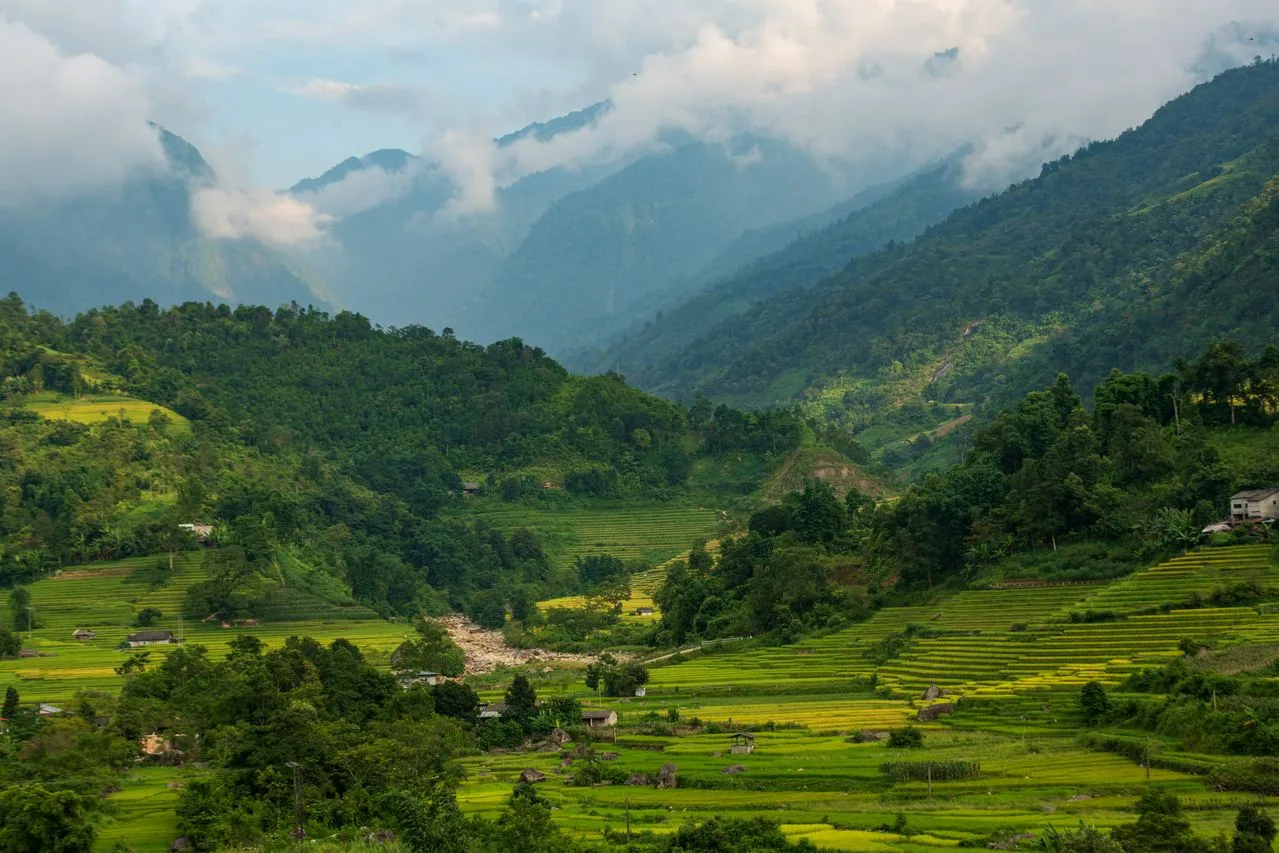
Vietnam has one major problem from the perspective of someone planning their first vacation: it is very long. From the mountains near the Chinese border to the tropical islands in the south, the country stretches for over 1,600 kilometers. When you might need a jacket in Hà Giang, you could be lying under a palm tree on Phú Quốc. When the central coast is flooded with autumn rains, the north can enjoy some of the most beautiful weather of the year.
That’s why the question “When is the best time to go to Vietnam?” doesn’t have a single correct answer. Instead, it has a much more interesting one: first, choose the Vietnam you want to see. Should it be vertical mountains and roads winding over cliffs? Rice paddies tucked between limestone rocks? Imperial palaces? A city illuminated by thousands of lanterns? The largest caves in the world? Life centered around the river? Or perhaps a tropical island and a dinner featuring fish caught just a few hours earlier?
Vietnam changes with every region. And right along with the landscape, the food changes too. In the north, you’ll find buckwheat, corn, smoke-cured meat, and spices native to the mountain ethnic groups. In the former imperial city of Huế, you’ll get tiny, meticulously crafted bánh bèo. In Hội An, a noodle dish exists almost entirely thanks to the history of that one specific town. In the Mekong Delta, fish are pulled straight from the rivers, and coconut serves as a vegetable, a drink, a dessert, and a sauce ingredient all at once. And on Phú Quốc, Vietnam’s most essential seasoning ages for months in massive wooden barrels. That is why the best trip to Vietnam can be planned not just through places, but through flavors.
First, the most important question: when is the best time to go to Vietnam?
If you want to see the north, central region, and south all in one trip, the most universal period is usually March and April. The official Vietnam Tourism portal points to the period from March to May as the time when, statistically, it is easier to find good weather in multiple parts of the country at the same time.
However, this does not mean it is automatically the best time for every region. Simply put:
- North of Vietnam: a very good period is usually March–May and September–November.
- Central Vietnam: usually performs particularly well around February/March to June, depending on the specific location.
- Southern Vietnam and the Mekong Delta: temperatures are high year-round, but the driest period typically falls during the winter months.
- Phú Quốc: the classic prime beach season falls during the dry season, roughly from November to April.
The biggest mistake? Planning a three-week trip across the entire country based on the forecast for Hanoi. Vietnam features multiple distinct climate systems. Planning a trip during the warmer months? Check out our guide on what to eat in the summer in Vietnam and Thailand.
If you can only go once: which month should you choose?
For a first, all-inclusive trip through Vietnam, I would choose March or April. Why? In the north, it starts getting much more pleasant. Central Vietnam gets plenty of sunshine. Phong Nha is in a prime period for exploring caves. Huế and Hội An can be visited without the heavy risk of autumn downpours. In the south, you can still catch a great season. On the other hand, if your trip focuses primarily on Northern Vietnam and Hà Giang, October and November can also be exceptionally beautiful. And it is precisely from the north that we will begin.
Hà Giang. A Vietnam that feels like the edge of the world
If you had to pick the most spectacular inland landscape in Vietnam, Hà Giang would be one of the top contenders. This is the far north of the country, right along the border with China. The road winds between massive limestone mountains, valleys, cultivated terraces, and villages inhabited by the Hmong, Dao, Tày, Nùng, and other ethnic groups. The most famous route is the Hà Giang Loop. The Mã Pí Lèng Pass, the Đồng Văn Karst Plateau, the Sủng Là Valley, and the Nho Quế River create a landscape entirely different from postcard-tropical Vietnam. You won’t find palm trees here. It’s all about rugged rocks, mist, cornfields, steep slopes, and tiny houses clinging to the mountainsides.
When is the best time to visit Hà Giang?
One of the most picturesque times to visit is autumn. Buckwheat flowers start blooming from late September. By October and November, the fields are carpeted in shades of white, pink, and purple, and around November, a festival celebrating buckwheat takes place. June looks completely different. The rainy season kicks off, turning the mountains an intense green, waterfalls surge with full power, and the rice terraces are flooded with water. However, if your main goal is riding along mountain roads, the drier autumn months are generally much easier logistically.
What to eat in Hà Giang?
This is where one of Vietnam’s most fascinating culinary chapters begins. Hà Giang’s cuisine isn’t just “Vietnamese mountain food.” The region is home to numerous ethnic groups, each bringing its own ingredients, techniques, and rituals to the table.
In the local cuisine, you will find:
- buckwheat,
- corn,
- sticky rice,
- smoke-dried meat,
- local herbs,
- mắc khén,
- hạt dổi,
- cardamom,
- anise,
- honey.
Vietnam Tourism describes the cuisine of the Hà Giang plateau as the result of the daily life of the region’s 19 ethnic groups.
Thắng cố: a dish that isn’t made specially for tourists
One of the most characteristic dishes is thắng cố, traditionally associated primarily with the Hmong community. Historically, it was prepared from horse meat, using meat, bones, and offal simmered for a long time in a large cauldron with aromatic spices. Today, you can find versions made with beef, buffalo, or pork. The broth includes anise, cardamom, and aromatic leaves, among other ingredients. This dish is best understood not as an elegant restaurant soup, but as market and community food. A large pot. A few people. Cold mountain air. Often accompanied by corn liquor. Traditionally, thắng cố is eaten alongside corn products like mèn mén.
Bánh tam giác mạch, or: eat the landscape you were just photographing
Tam giác mạch means buckwheat—the very same plant whose pink fields draw thousands of travelers every autumn. The seeds are ground into flour to make small cakes or flatbreads, providing a fascinating example of a product shaped directly by the region’s geography. According to a local tale shared by Vietnam Tourism, buckwheat once became a vital food source during a period when rice and corn were scarce. So when you’re in Hà Giang, don’t just photograph the buckwheat—make sure to taste it too.
Xoi ngu sac: Five-color sticky rice
This is one of the most beautiful dishes of the northern ethnic groups. Sticky rice is colored with natural plants in several hues. The traditional five colors symbolize the five elements and the harmony of the world. The dish appears especially during holidays, important meetings, and celebrations, as a symbol of prosperity, unity, and abundance. It is eaten warm, sometimes with sesame salt or meat additions. This is not ‘colorful rice for Instagram.’ The colors have meaning.
Who is Ha Giang for?
- For someone who wants to see the most rugged, mountainous Vietnam.
- For someone interested in ethnic minority cultures.
- For a traveler who values landscape, local markets, and homestays more than a five-star resort.
- And for someone who is ready to try food very different from the pho known in European restaurants.
2. Ninh Binh. Ha Long Mountains, but rising from rice fields
From Ha Giang, let’s move about 90 kilometers south of Hanoi. Ninh Binh looks a bit like someone took the limestone islands of Ha Long Bay and placed them in the middle of rice fields. Tall karst rocks rise vertically from the plain. Rivers flow between them. Boats enter caves. Temples and pagodas stand on the banks.
The most famous places are:
- Trang An,
- Tam Coc,
- Bich Dong,
- Hoa Lu,
- Hang Mua.
In Trang An, a boat glides between jungle-covered limestone mountains, passing through caves and past temples.
When is Ninh Binh most beautiful?
If we are looking for the most photographic landscape of Tam Coc, the exceptional period falls in late May and early June. The rice fields ripen then and turn intense golden colors. The Ngo Dong River cuts through the golden fields between dark limestone walls. If milder temperatures are more important, spring or autumn are also excellent choices.
What to eat in Ninh Binh?
Two products appear almost always: goat and com chay.
Why goat?
Ninh Binh is a rocky region. Goats are raised on limestone hills and have become one of the symbols of local cuisine. The most characteristic dish is de tai chanh. Goat meat is lightly processed, then combined with lime juice, chili, lime leaves, and sesame. The taste is therefore completely different from a heavy roast. Sour. Aromatic. Herbal. Slightly spicy.
Com chay: the best part of the rice is what sticks to the pot
Com chay is a crispy layer of rice. In the past, scorched rice remaining at the bottom of the pot was not something to be thrown away. It became a snack. In Ninh Binh, crispy rice sheets can be eaten alone or dipped in a thick, warm sauce or stew. This is a very Vietnamese approach: something that might look like kitchen ‘waste’ is transformed into a regional specialty.
Why combine Ninh Binh with Hanoi?
Because the contrast is perfect. Hanoi is noise, scooters, street food, old tenements, and coffee. Ninh Binh is silence, cycling among fields, limestone rocks, and a boat gliding on the water. They are only hours apart by travel.
3. Ha Long Bay and Lan Ha. Vietnam like an old Chinese painting
Over 1600 limestone formations rising from the water have made Ha Long one of the most recognizable landscapes in all of Asia. The best way to experience the bay is not a quick stop at a viewpoint. It is worth spending a night on the water. In the afternoon, kayak. In the evening, watch the sunset. In the morning, see the limestone islands emerge from the fog. Vietnam Tourism recommends a cruise with an overnight stay as the best way to explore the bay.
When to go?
Good periods are especially April-June and September-November. In summer, it is hot and humid, and tropical storms can lead to cruise cancellations. In winter, the bay can be cool and foggy. However, this fog has its admirers. Then Ha Long looks more mysterious than tropical.
What to eat?
In the region, it is particularly worth noting cha muc, or fried squid patties. This is one of Ha Long’s local symbols. Squid meat is minced, shaped, and fried, but should retain its characteristic elasticity. The best context for eating? Simply the port. The sea. Fresh seafood. Cuisine here has a geographical sense.
4. Phong Nha-Ke Bang. Underground Vietnam
If Ha Long shows what water has done to limestone above ground, Phong Nha-Ke Bang shows the result underground. The National Park is a huge system of limestone mountains, tropical forest, underground rivers, and hundreds of caves. It is home to Son Doong, considered the largest known cave in the world, with its own vegetation and enormous chambers. But you don’t need to participate in a multi-day, very expensive expedition for Phong Nha to make a huge impression.
Paradise Cave, Phong Nha Cave, Dark Cave, Hang En, or Tu Lan allow you to explore the region at various difficulty levels. On the surface are rivers, rice fields, villages, and limestone mountains. This is one of those places where even a simple bike ride between villages looks like a movie set.
When to go to Phong Nha?
It is safest to plan a visit during the dry season. Vietnam Tourism indicates March-August as a very good period, with particularly good conditions in spring. Intense autumn rains can raise river levels and lead to cave closures. If Phong Nha is the main point of the trip, October and November are not the best times.
What to eat in Phong Nha?
Here, rural cuisine is more interesting than a single ‘national’ dish.
- Chicken grilled over fire.
- Fresh herbs.
- Pork with lemongrass.
- Peanut sauces.
- Local honey.
In the Bong Lai valley, one of the most characteristic experiences is a very simple meal: grilled chicken with homemade peanut sauce, eaten after a bike ride through the village. This is a good lesson in Vietnamese food. Not every most memorable dish has a complicated name. Sometimes chicken from the fire tastes best because an hour earlier you walked through the jungle and a river.
5. Hue. If you are interested in food, this city cannot be missed
If I had to name one city for someone particularly interested in the history of Vietnamese cuisine, Hue would be a very strong candidate. It is the former imperial capital of the Nguyen Dynasty. Along the Perfume River are: the Citadel, the Forbidden Purple City, pagodas, gardens, and monumental imperial tombs. But a second Hue is found on the plate. Due to the presence of the court, a uniquely precise culinary culture developed in the city. Small portions. Many dishes. Contrasting colors. Decoration. Distinctly spicier flavors than in the north. Vietnam Tourism indicates that the history of the imperial court had a huge impact on the richness of local cuisine.
What to eat in Hue?
Not just bun bo Hue. Although it’s a good place to start.
Bun bo Hue for breakfast
In Poland, a bowl of spicy beef broth might seem like dinner. In Hue, it is a perfectly natural breakfast. The broth is flavored with lemongrass, fish sauce, and characteristic additions. Traditional versions also include shrimp paste. Bun noodles and meat are added. Herbs, lime, and chili await on the table. Official Vietnam Tourism materials describe bun bo as a popular morning meal for residents of the former capital.
Banh beo: food in a porcelain saucer
This is one of the most characteristic things you can order in Hue. A tiny portion of rice cake is steamed directly in a small ceramic dish. Toppings include dried shrimp, pork cracklings, shallots, and scallion oil. A few drops of fish sauce are added. And eaten. Then another saucer. And another. One portion is tiny, but that’s the point. Hue loves the variety of small dishes.
Banh bot loc: transparent cake
Made from tapioca. After cooking, the dough becomes translucent and springy, and a shrimp and a piece of pork can be seen through its surface. It can be wrapped in a banana leaf. For a European, the texture is initially unusual. For a resident of Hue, the texture is one of the reasons why the dish is good.
Banh khoai
A crispy pancake made from rice flour and turmeric is filled with shrimp, pork, and sprouts, among other ingredients. But the most interesting part is how it’s eaten. Vegetables, sour fruits, and a thick sauce traditionally prepared with peanuts and liver are served with the pancake. Each bite should be simultaneously: crispy, fatty, sour, fresh, salty.
When to go to Hue?
April is a very good month. Vietnam Tourism indicates it as a month with very good weather conditions and plenty of sunshine. Late autumn can be significantly rainier.
6. Hoi An and Da Nang. The best combination of beach, city, and food
If your first trip to Vietnam is meant to be simultaneously: beautiful, comfortable, romantic, culinary, and not too extreme, the area around Hoi An and Da Nang is one of the best choices. Da Nang offers wide beaches, the Son Tra peninsula, mountains, and modern infrastructure. Hoi An, about half an hour away, offers historic yellow houses, narrow streets, a river, and thousands of lanterns. It was once one of the most important trading ports in the region. Chinese, Japanese, and Europeans came. And everyone left their mark. In architecture. In trade. And in food.
What to eat in Hoi An?
Above all: cao lau. If there is a dish that is difficult to separate from one specific city, it is cao lau.
Cao lau: Hoi An in a bowl
The noodles are thicker and more springy than typical bun. Pork, herbs, sprouts, and crispy elements appear on top. But unlike pho, it does not swim in a large amount of broth. It only receives a small amount of intense liquid. Tradition links the characteristic noodles to local water and ancient methods using plant ash. Vietnam Tourism even describes cao lau as “Hoi An in a bowl”. This dish is an interesting trace of the port’s history. The noodles somewhat resemble Japanese udon. The pork might bring to mind Chinese char siu. The herbs are very Vietnamese. And the whole is not an exact copy of any of these cuisines. It is Hoi An.
Rau Tra Que: why do herbs have their own village?
A few kilometers from the old town lies Tra Que Vegetable Village. This is where some of the fresh vegetables and herbs used in local dishes come from. And that’s why Hoi An cuisine is interesting. In a dish like cao lau, the herb is not a decoration. It is a full-fledged ingredient. Vietnam Tourism emphasizes the importance of fresh produce from Tra Que for local dishes.
What to eat in Da Nang?
Mi Quang
This is one of the most important dishes of the Quang Nam region. Thick rice noodles. A small amount of intense broth. Meat or seafood. Herbs. Peanuts. Crispy rice cracker. There is no single rigid recipe, but peanuts and a crispy element are characteristic. Mi Quang is not a soup in the same sense as pho. There is little liquid. Everything is mixed in the bowl.
Banh trang cuon thit heo
Simplicity: boiled or roasted pork, rice paper, lots of herbs, vegetables. You roll everything yourself. Then you dip it in mam nem, an intense fermented fish sauce. This is a good dish to understand the Vietnamese table. The cook doesn’t always serve a finished bite. They give you the elements. You build the bite yourself.
Seafood eaten by the sea
In Da Nang, in the evening, it’s worth doing something very simple. Go towards the coast. Choose fish, clams, squid, crabs, or shrimp. And order them prepared as simply as possible. Vietnam Tourism emphasizes that local seaside establishments often allow you to choose fresh seafood almost directly from the day’s catch. You don’t always have to look for the most complicated recipe. Sometimes regionality simply means: the sea is a hundred meters away.
When to go to Hoi An and Da Nang?
A very good period is approximately from March to June. Spring offers plenty of sunshine without the most intense part of the later season. In autumn, central Vietnam has a much higher risk of intense rainfall and floods.
7. Mekong Delta. Vietnam where the road is a river
In the south, the landscape changes completely. There are no more big mountains. There is water. A huge network of rivers, branches, canals, and islands forms the Mekong Delta. Fruits are transported by boat. You go to the market by boat. Houses stand on the water. Fish are farmed in ponds. Coconut palms and orchards grow along the canals. The fertile sediments deposited by the Mekong have made the region one of the most important areas for rice, vegetable, and tropical fruit production in the country. If northern Vietnam shows mountains, the delta shows abundance. And you can taste it. Southern Vietnamese food is sometimes sweeter than northern cuisine.
Where to go in the delta?
For a first visit, Can Tho is an excellent base. From there, you can set off early in the morning to the Cai Rang market. Even before breakfast, the river fills with boats carrying watermelons, pineapples, pumpkins, and other produce. Goods are displayed high on long poles so that it is clear from a distance what each boat is selling. Small boats with coffee and breakfast pass between the larger vessels. This is one of the few situations where you can order a bowl of noodles without going ashore.
What to eat in the Mekong Delta?
Ca tai tuong, or elephant ear fish standing on the table
One of the most spectacular dishes is whole fried elephant ear fish. It is served vertically. An elegant fillet is not cut for the guest. You tear off pieces of meat yourself. Then you add: herbs, cucumber, pickles, noodles, rice paper. You roll everything up. And dip it in sauce. This is another example of interactive eating characteristic of Vietnam.
Canh chua
A sour soup particularly strongly associated with the south and the delta. It may contain:
- fish or shrimp,
- tamarind,
- pineapple,
- tomatoes,
- sprouts,
- local stems and herbs.
- It is sour, sweetish, and aromatic.
In Can Tho, it appears as a natural part of the region’s family cuisine.
Ca kho to
Fish slowly braised in a clay pot with caramel and fish sauce. Two elements exceptionally characteristic of the south meet in its taste: sweetness and fishy umami. It is served with rice, not as a standalone dish. The rice absorbs the intense sauce.
Ben Tre: here coconut is not a dessert
If you go to Ben Tre, you will see how many uses coconut can have. You can try:
- coconut rice,
- shrimp braised with coconut,
- salad with young coconut palm heart,
- coconut candies.
Cu hu dua, the delicate coconut palm heart, can be sliced and used in a salad. This is a good example of the difference between European and tropical cuisine. For us, coconut is primarily a dessert flavor. In the delta, it is part of an entire culinary system.
Chau Doc: kingdom of fermented fish
Further west lies Chau Doc. The city is strongly associated with fermented fish products and is sometimes referred to as the ‘kingdom of pickled fish.’ It is also a place where Vietnamese, Khmer, and Cham cultures meet. Thus, a different Vietnam can be seen on the local table than in Hanoi. For dessert, it is also worth trying sweets made from local palm sugar, coconut, and palm fruits.
8. Phu Quoc. An island where you first go to the beach, then discover fish sauce
If the trip is to end with a few days of truly tropical relaxation, Phu Quoc is one of the most obvious choices. White beaches. Turquoise water. Islands of the An Thoi archipelago. Coral reefs. Sunsets. But Phu Quoc is more culinarily interesting than the image of a luxury resort suggests. The island is famous for:
- seafood,
- pepper,
- fish sauce,
- raw herring salad,
- bun quay.
Goi ca trich. Vietnamese raw herring
One of the local specialties is goi ca trich. Fresh herring is combined with additions, herbs, and vegetables. Individual elements are wrapped in rice paper and dipped in sauce. This dish utilizes the island’s most important asset: the fish is truly fresh. It is worth eating it where the product has the shortest journey between the sea and the plate.
Bun quay. Soup you have to ‘stir’ yourself
The name quay means mixing. Noodles and fresh ingredients, including seafood, appear in the bowl. But one of the most interesting elements of the experience is preparing your own sauce. In many places, the guest mixes a combination of spices and additions at the table to achieve the desired balance. This is another example of cuisine where the diner is not passive. Seasoning is part of eating.
Nuoc mam Phu Quoc. The most important thing you almost don’t see on the plate
If someone is truly interested in Vietnamese cuisine, they should visit a nha thung in Phu Quoc, a traditional fish sauce production facility. Small fish, especially anchovies, are covered with salt. Then they ferment for months in huge wooden barrels. The resulting liquid is one of the foundations of Vietnamese cuisine. It is not equivalent to European salt. It is simultaneously: salty, fishy, fermented, full of umami. Vietnam Tourism considers a visit to a fish sauce factory one of the most important culinary experiences on the island. And it’s worth doing something else. Tell yourself: I will try good nuoc mam separately. Then it’s easier to understand why a few drops can completely change a bowl of broth or spring roll sauce.
When to go to Phu Quoc?
If the main goal is primarily the beach, the best time will be the generally dry season from late autumn to spring. Therefore, Phu Quoc combines perfectly with a winter trip to southern Vietnam. During the rainy season, the island still functions, but the sea and weather can be less predictable.
And where are Hanoi and Saigon in all this?
I would not include them on the list of Vietnam’s most spectacular landscapes. But culinarily, they are absolutely essential.
Hanoi
This is the place for:
- pho,
- bun cha,
- cha ca,
- bun thang,
- banh cuon,
- cà phê trứng (learn more about the history of Vietnamese coffee)
Northern cuisine is usually more delicate and less sweet than southern cuisine. Vietnam Tourism describes the north as a region that prefers more subtle flavors and a strong attachment to ancient traditions.
Ho Chi Minh City
Saigon is the opposite. Faster. Louder. More multicultural. Southern cuisine more readily uses sugar, tropical herbs, and the abundance of delta products. Here it is worth looking for, among other things:
- com tam,
- banh xeo,
- hu tieu,
- oc, which is a huge culture of eating snails and seafood,
- ca phe sua da.
Therefore, the best way to travel in Vietnam is not to choose between city and nature. Cities show everyday Vietnam, and regions show where its food comes from.
What would an ideal first culinary trip to Vietnam look like?
If we have about three weeks and want to see a truly diverse country, a very interesting route could look like this:
Hanoi → Ha Giang → Ninh Binh → Hue → Hoi An/Da Nang → Mekong Delta → Ho Chi Minh City → Phu Quoc.
Phong Nha can be included between Ninh Binh and Hue, especially in March, April, or May. This is not a trip through seven versions of the same Vietnam. These are practically several different worlds. In Ha Giang, we eat buckwheat because on the rocky slopes it has been a real source of food for generations. In Ninh Binh, we eat goat because the landscape is rocky. In Hue, we eat tiny, precise dishes because the culture of the imperial court developed there for generations. In Hoi An, we eat cao lau because the city was a trading port where influences from various cultures mixed. In the delta, we eat fish, fruits, and coconut because life springs from the river. In Phu Quoc, we try nuoc mam because the sea has provided the fish needed for fermentation for generations. This is the most important thing you can discover during a culinary journey through Vietnam: regional dishes were not created because someone needed another item on a restaurant menu. They were created because people cooked with what grew, swam, or lived around them.
What absolutely must you eat during your first vacation in Vietnam?
If I had to create a list not of the biggest tourist hits, but of dishes that allow you to understand different parts of the country, I would choose:
- In Ha Giang: banh tam giac mach and xoi ngu sac.
- In Ninh Binh: de tai chanh and com chay.
- In Hanoi: bun cha and cha ca.
- In Ha Long: cha muc.
- In Hue: bun bo Hue, banh beo, and banh bot loc.
- In Hoi An: cao lau.
- In Da Nang: mi Quang and banh trang cuon thit heo.
- In the Mekong Delta: canh chua, ca kho to, and ca tai tuong wrapped with herbs in rice paper.
- In Ben Tre: something prepared with young coconut.
- In Phu Quoc: goi ca trich, fresh seafood, and authentic nuoc mam from the island.
And in between? Plenty of fruit. Try traditional Asian Chè desserts and coffee. And things whose names you won’t be able to remember, ordered because they looked good at the neighboring table. Sometimes those turn out to be the best.
How to truly eat when traveling in Vietnam?
First rule: don’t look for everything in one restaurant.
If a place has a four-page menu containing pho, curry, pizza,
Second rule: see where the locals eat.
A plastic chair does not indicate the quality of the food. Neither does the lack of a tablecloth. Sometimes the best meal of the trip will be eaten at a metal table set a meter from a busy street.
Third: observe others.
Some dishes come with their own instructions. Rice paper needs to be moistened. Herbs put inside. Sauce added to the bowl or used for dipping. Phin coffee needs time. Fresh vegetables lying next to the dish are not decoration. If you don’t know what to do, the easiest way is to look at the next table.
The best month for Vietnam therefore depends on what you want to see
If you want to travel across the entire country as comfortably as possible, I would aim for:
March-April
The most universal compromise. A good time for central Vietnam, favorable for Phong Nha, and reasonable for many places in the north and south.
May-June
An excellent choice if you particularly care about the golden fields of Ninh Binh and the beaches of the central coast. In the north, however, it gets hot and humid.
September-November
A fantastic period for the north. Hanoi becomes more pleasant, Ha Giang delights with its autumn landscape, and buckwheat begins to bloom. But this is also a period when central Vietnam can experience intense rains.
December-February
A good choice for the south and Phu Quoc. In the north, it can be really cold, especially in the mountains. Contrary to stereotype, Vietnam is not a country where shorts are sufficient 365 days a year.
The most beautiful Vietnam is not in one place
Hà Giang stuns with its scale. Ninh Bình with its tranquility. Hạ Long with its surreal landscape. Phong Nha with a sense of discovering another world. Huế with its history. Hội An with its atmosphere. The Mekong Delta with everyday life on the water. Phú Quốc with its tropical sea.
But only food explains why each of these places is different. When we travel through Vietnam solely from one attraction to another, we only see the landscape. When we start eating locally, we begin to understand why that landscape looks and functions just the way it does.
Buckwheat speaks of the mountains of Hà Giang. Goat of the limestone hills of Ninh Bình. Herbs of the land around Hội An. Cá kho of the Mekong rivers. Nước mắm of the sea surrounding Phú Quốc.
That is why a culinary journey through Vietnam is not just a holiday extra—it is one of the best ways to truly know the country. And that is precisely why the origin of dishes matters so much to us at Wi-Taj—explore the classics of Vietnamese cuisine on the Wi-Taj menu. Behind the name of a dish, you will very often find a specific province, climate, history, and way of life of the people who prepared it long before it ever reached a restaurant menu.
Got the travel bug?
Book a table at Wi-Taj restaurant at 4 Plac Konstytucji or order authentic dishes for home delivery and discover the flavors of Vietnam in Warsaw.
Bibliography and sources
- Vietnam National Authority of Tourism, “Weather and climate in Vietnam”. The main source regarding regional climatic differences and the best travel periods for northern, central, and southern Vietnam.
- Vietnam National Authority of Tourism, “Where to go in Vietnam: a monthly guide”. Seasonality of individual destinations, including Hue, Da Nang, and Ha Long.
- Vietnam Tourism, “The Ha Giang Loop”. The landscape of Ha Giang and local products and dishes, including xoi ngu sac and buckwheat products.
- Vietnam Tourism, “Local unpacked: One of a kind cuisine of Ha Giang karst plateau”. Detailed source on the cuisine of Ha Giang ethnic groups, thang co, chao au tau, buckwheat, spices, and traditional products of the region.
- Vietnam Tourism, “The Buckwheat Bounty of Ha Giang”. The history of buckwheat in Ha Giang and the blooming season from autumn to early winter.
- Vietnam Tourism, “Five-colour sticky rice, the quintessence of Vietnamese cuisine”. Symbolism and traditional preparation method of xoi ngu sac.
- Vietnam Tourism, “10 must-do activities in Ninh Binh”. Source on regional specialties of Ninh Binh, particularly de tai chanh and com chay.
- Vietnam Tourism, “Ninh Binh: A journey through golden valleys”. The season of Tam Coc’s golden fields and the characteristics of Ninh Binh’s landscape.
- Vietnam Tourism, “5 must-see heritage sites in Vietnam”. Information regarding Ha Long Bay and Phong Nha-Ke Bang National Park.
- Vietnam Tourism, “Phong Nha”. Information about caves, travel conditions, seasonality, and local eating style in the Bong Lai area.
- Vietnam Tourism, “How to eat like a local in Hue”. Detailed study of the history of Hue’s imperial cuisine and banh beo, banh nam, banh bot loc, banh khoai, and other local dishes.
- Vietnam Tourism Board, “Recipes from Vietnam”. Source on bun bo Hue and its significance in the local breakfast culture.
- Vietnam Tourism, “Explore the food of Hoi An”. History of Hoi An as a trading port, cao lau, and the importance of products from Tra Que.
- Vietnam Tourism, “Da Nang: Eat, Play, Relax”. Local mi Quang, banh trang cuon thit heo, mam nem, and the culture of eating fresh seafood.
- Vietnam Tourism, “Dining in the Delta”. Detailed source on Mekong Delta cuisine, ca tai tuong, ca kho, fruits, fermented fish, and floating markets.
- Vietnam Tourism, “4 memorable days in the Mekong Delta”. Canh chua, Cai Rang, breakfasts sold from boats, Ben Tre, and local coconut culture.
- Vietnam Tourism, “A Day in Phu Quoc”. Goi ca trich, bun quay, fresh seafood, and the tradition of nuoc mam production.
- Vietnam Tourism, “7 incredible islands in Vietnam”. Phu Quoc, local seafood, pepper and fish sauce, and the island’s landscape.
- Vietnam Tourism, “Vietnam: A foodie guide by region”. General differences between northern, central, and southern Vietnamese cuisine and the cultural sources of regionalization of Vietnamese food.